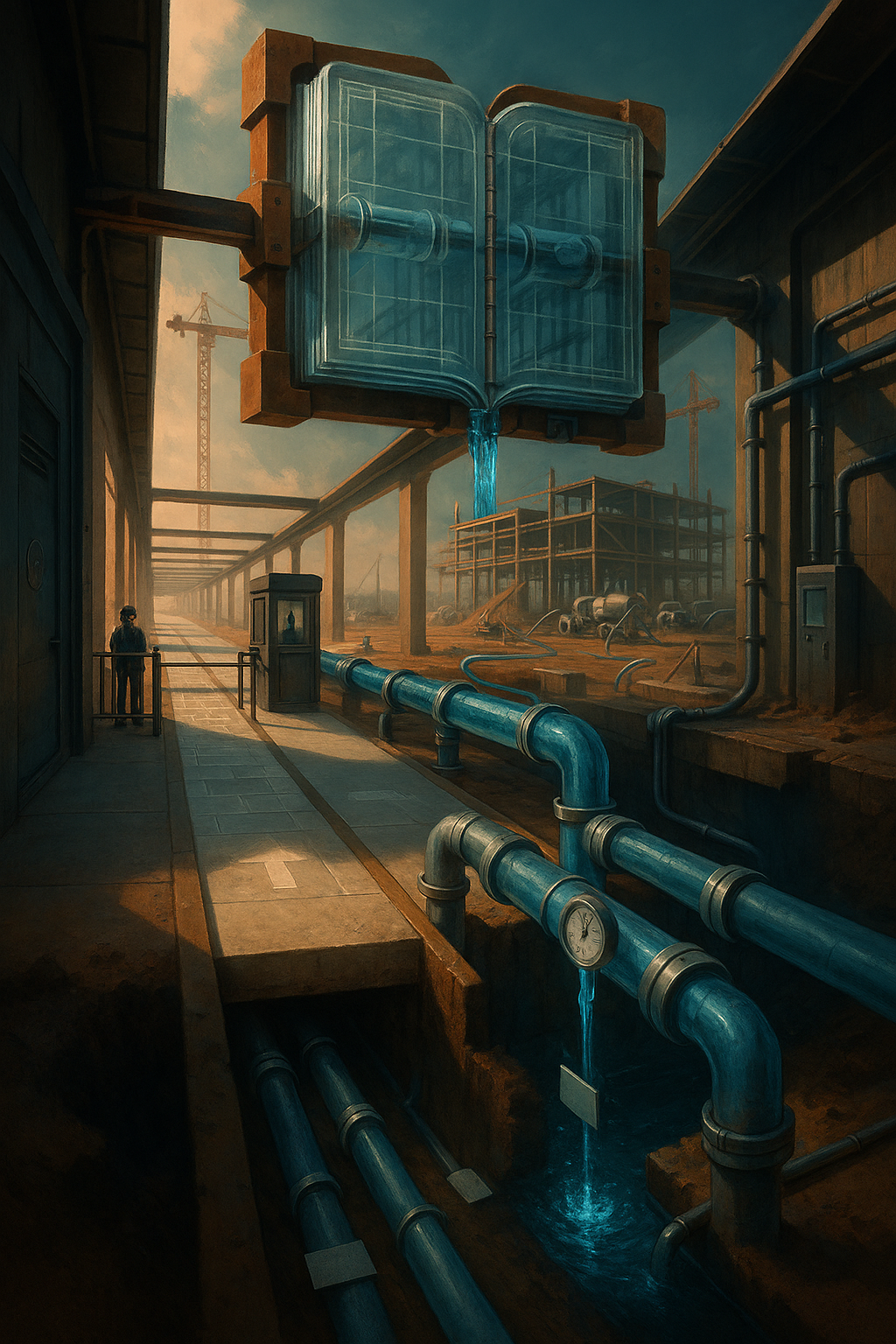
The QTS water story in Georgia is not just a water story. It is a control-system story.
E&E News reported that residents in Fayetteville, Georgia noticed unusually low water pressure before the county utility found two industrial-scale hookups feeding a QTS data center campus. One connection was reportedly unknown to the utility, and the other was not linked to the company's billing account. The result: more than 29 million gallons of unaccounted-for water and a $147,474 retroactive charge.
The thesis: AI infrastructure operators cannot defend a project with operational sustainability claims if construction-phase resource controls are loose.
The Hidden Phase
Most data-center debates focus on steady-state operations: megawatts, cooling design, water usage effectiveness, renewable procurement, and grid interconnection.
That misses the messy phase where trust can break first: construction.
QTS says its data centers use closed-loop cooling that does not consume water for cooling once operational. Its public FAQ for another campus says a typical operational building uses about 50,000 gallons a month for everyday needs such as bathrooms, kitchens, irrigation, cleaning, and humidification, roughly what four households use.
That may be true for operations. It does not solve construction governance.
Concrete work, dust control, site preparation, initial system fills, temporary service lines, contractor handoffs, meter setup, and account linkage all happen before the clean operating story is visible. If those controls are weak, the project can lose public credibility before the first full production workload arrives.
The Operator Lesson
The lesson is not "data centers always drain communities." That is too blunt.
The better lesson is this: AI infrastructure needs a construction water ledger.
For every large campus, operators should be able to answer five questions in real time:
1. Which temporary and permanent water connections exist?
2. Which contractor, account, meter, permit, and project phase owns each connection?
3. What usage is expected this week, and what threshold triggers review?
4. Who gets alerted when billed usage, metered usage, and permitted usage diverge?
5. What can local officials and residents see without filing records requests?
That is basic operational hygiene. It should not depend on one overworked local staffer, a manual spreadsheet, or a resident noticing pressure changes first.
Why Scale Changes The Standard
QTS is not building a small server room. Georgia's development record lists ATL2 East as a Fayetteville project from QTS Eastwood, LLC. Data Center Dynamics reported the ATL2 East filing as a 2 million-square-foot project on about 313 acres, and described the broader Project Excalibur plan as 6.6 million square feet across 16 buildings on a 615-acre site.
At that scale, "we will use little water once operational" is not enough.
Large AI infrastructure projects are becoming civic infrastructure. They touch water, power, roads, emergency response, land use, tax revenue, jobs, and noise. The operator standard has to rise with the footprint.
That means the construction phase needs the same seriousness as the data hall: observability, ownership, anomaly detection, escalation, audit trails, and public reporting.
The Founder Opportunity
There is a real software wedge here.
Local governments and industrial developers need systems that connect utility data, permits, construction schedules, meters, account records, public commitments, and exception workflows.
The product is not another dashboard for sustainability marketing. It is infrastructure trust software:
- meter-to-permit reconciliation
- construction consumption forecasts
- contractor-owned connection logs
- threshold alerts for utilities and developers
- public-facing project resource summaries
- immutable audit trails for contested usage
AI can help by reading permits, extracting commitments from public filings, flagging anomalies, summarizing variance explanations, and preparing regulator-ready evidence packets. But the core value is operational accountability, not prettier reporting.
Investor Intelligence, Without The Trade
For market observers, the signal is broader than one QTS campus or one Georgia utility.
AI infrastructure risk is no longer only chip supply, power contracts, or capex discipline. It is also local execution risk. Projects can be delayed, restricted, litigated, or politically damaged when resource promises and visible local experience diverge.
That does not mean every data-center project is fragile. It means the best operators will treat community resource controls as part of the infrastructure stack.
The winners will not just secure GPUs, substations, and fiber. They will secure trust.
The Takeaway
Closed-loop cooling is an operating claim. Construction water control is an execution system.
AI data-center builders need both.
The practical standard is simple: before a campus asks a community to trust its long-term efficiency story, it should be able to show every major construction-phase resource draw, who owns it, what was expected, what changed, and who was notified.
In the AI buildout, the next bottleneck may not be a model, chip, or power purchase agreement. It may be whether the local ledger matches the local promise.
Sources
- https://www.eenews.net/articles/georgia-residents-seethe-over-30m-gallons-of-missing-water/
- https://q.com/data-centers/qts-pennsylvania/
- https://apps.dca.ga.gov/DRI/AppSummary.aspx?driid=4603
- https://www.tomshardware.com/tech-industry/georgia-data-center-used-29-million-gallons-of-water
- https://www.datacenterdynamics.com/en/news/qts-files-to-expand-fayetteville-data-center-campus-in-georgia/