Enterprise agents do not become useful because they sound autonomous. They become useful when they can act inside real systems without turning every permission, process, and audit trail into a liability.
That is the useful read on SAP and NVIDIA's new agent partnership. NVIDIA says SAP is embedding NVIDIA OpenShell into SAP Business AI Platform as the runtime security layer for SAP AI agents and custom agents built in Joule Studio. SAP's Sapphire announcement puts that move inside a broader Autonomous Enterprise push: a unified SAP Business AI Platform, more than 50 planned domain-specific Joule Assistants, and more than 200 specialized agents.
The thesis: enterprise AI agents will be adopted through runtime contracts, not demo magic.
The Real Move
Most agent demos focus on reasoning. SAP and NVIDIA are focusing on permissioned execution.
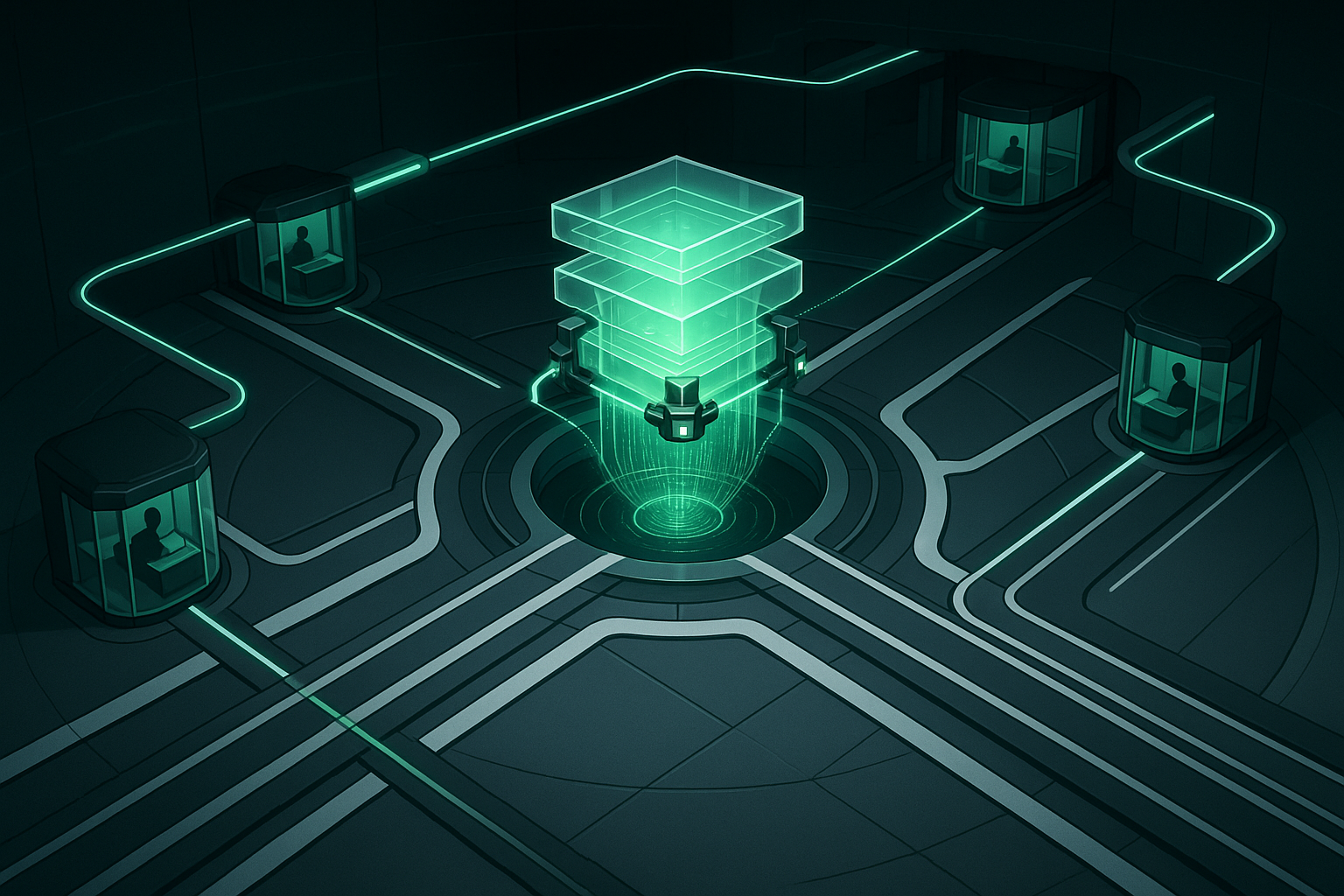
OpenShell is described as a runtime for autonomous agents with isolated execution environments, policy enforcement at the filesystem and network layers, and infrastructure-level containment. In plain English: it is meant to limit what an agent can see, touch, and execute when agent logic fails or wanders.
That matters because SAP sits close to systems of record: finance, procurement, supply chain, manufacturing, HR, and customer workflows. An agent that drafts a note is one risk profile. An agent that changes a payment, reconciles an account, creates a work order, or moves a supply-chain workflow is another.
SAP is also turning this into a platform story. Its new Business AI Platform unifies SAP BTP, SAP Business Data Cloud, and SAP Business AI into a governed environment. Joule Studio is the build surface. OpenShell is the execution boundary.
The Runtime Contract
The operator framework is simple: every production agent needs a runtime contract.
Scope: Which business process, role, and system can the agent touch?
Identity: Whose authority is the agent borrowing, and how is that mapped to enterprise identity?
State: Which data can the agent read, write, remember, or pass to another tool?
Action: Which steps can run automatically, and which require human approval?
Audit: What evidence proves the agent stayed inside policy after the fact?
Without that contract, "agentic AI" is just a softer word for uncontrolled automation. With it, agents can move from suggestion engines into bounded operators.
Why SAP Is A Good Test
SAP is not a casual place to test autonomy. ERP work is full of deterministic commitments: invoices, ledgers, purchase orders, inventory, compliance checks, month-end close, service tickets, and regulated industry processes.
That is why the SAP data points are worth watching. SAP says Joule is already live across 35 solutions, with more than 30 specialized agents and more than 2,500 Joule Skills in its Q1 update. At Sapphire, SAP expanded the roadmap to more than 50 Joule Assistants orchestrating more than 200 specialized agents.
Those numbers do not prove adoption or ROI by themselves. They do show the direction of travel: SAP wants enterprise users to interact through role-based assistants while agents perform narrower tasks underneath.
The hard part is not naming 200 agents. The hard part is making every agent safe enough to execute in a business process where accuracy, authorization, and auditability matter.
The Market Signal
For operators, this says the enterprise agent stack is separating into layers.
The model decides what might be useful. The application layer decides what should happen in business context. The runtime decides what can execute safely. The audit layer proves what happened.
For NVIDIA, that is an expansion from chips and infrastructure into the control plane for enterprise AI execution. For SAP, it is a bet that business context, process knowledge, and governed data access are the scarce assets in agent adoption.
For founders, the opportunity is around the boring middle: policy testing, action manifests, agent sandboxes, identity mapping, transaction review queues, audit logs, rollback tools, and domain-specific evaluation suites.
The next useful agent company may not look like a chatbot. It may look like a change-control system for AI actions.
The Practical Playbook
Teams evaluating enterprise agents should ask five questions before deployment:
1. What system of record can this agent affect?
2. What actions are blocked by default?
3. What policy layer is enforced outside the model prompt?
4. What logs would satisfy security, finance, legal, or operations after an incident?
5. What rollback exists if the agent is technically successful but operationally wrong?
If the answer is mostly prompt wording, the control plane is too weak.
The Takeaway
SAP and NVIDIA's move is not interesting because it makes agents sound more autonomous. It is interesting because it admits the opposite: enterprise autonomy needs hard boundaries.
The future of production agents will be less about whether the model can reason through a workflow and more about whether the runtime can keep that workflow inside a contract.
That is where enterprise AI starts to become infrastructure instead of theater.
Sources
- https://blogs.nvidia.com/blog/sap-specialized-agents/
- https://www.prnewswire.com/news-releases/sap-unveils-the-autonomous-enterprise-302769516.html
- https://news.sap.com/2026/04/sap-business-ai-release-highlights-q1-2026/
- https://www.constellationr.com/insights/news/sap-sapphire-2026-themes-ai-agent-accuracy-embedded-domain-knowledge-and-processes
- https://www.techtarget.com/searchSAP/news/366632263/SAP-pitches-role-based-Joule-assistants-as-ERP-work-partners