Cisco's latest quarter is not just a networking earnings story with AI language attached. It is a live example of what happens when AI demand forces a mature company to re-rank its own operating system.
On May 13, Cisco reported Q3 FY2026 revenue of $15.8 billion, up 12% year over year. Product orders rose 35%. Networking product orders grew more than 50%. The company also said it had taken $5.3 billion of fiscal year-to-date AI infrastructure orders from hyperscalers and raised its expected FY2026 AI infrastructure orders to $9 billion from $5 billion.
Then came the harder part: Cisco announced restructuring charges of up to $1 billion, and CEO Chuck Robbins told employees the company would reduce its Q4 workforce by fewer than 4,000 jobs, less than 5% of employees, while investing in silicon, optics, security, and employees' use of AI.
The thesis: AI infrastructure is becoming a capital-allocation test, not just a demand tailwind.
The Signal
The easy read is that AI demand is lifting networking. That is true, but incomplete.
AI clusters turn networks into production machinery. GPUs get the headlines, but distributed training, inference, storage movement, and cross-data-center traffic all need high-performance switching, routing, optics, telemetry, security, and supply-chain control.
That is why Cisco's order mix matters. Network World reported that Cisco saw $1.9 billion of Q3 hyperscaler AI infrastructure orders, up from $600 million last year, and that FY2026 AI infrastructure orders are expected to reach about 4.5 times FY2025 levels. It also reported more than $1 billion in Q3 orders for Cisco's Acacia optics business, plus over 750,000 400G and 40,000 800G coherent pluggable optics units shipped.
Those are not generic "AI adoption" facts. They point to the physical bottlenecks under the model economy.
The Capital Router
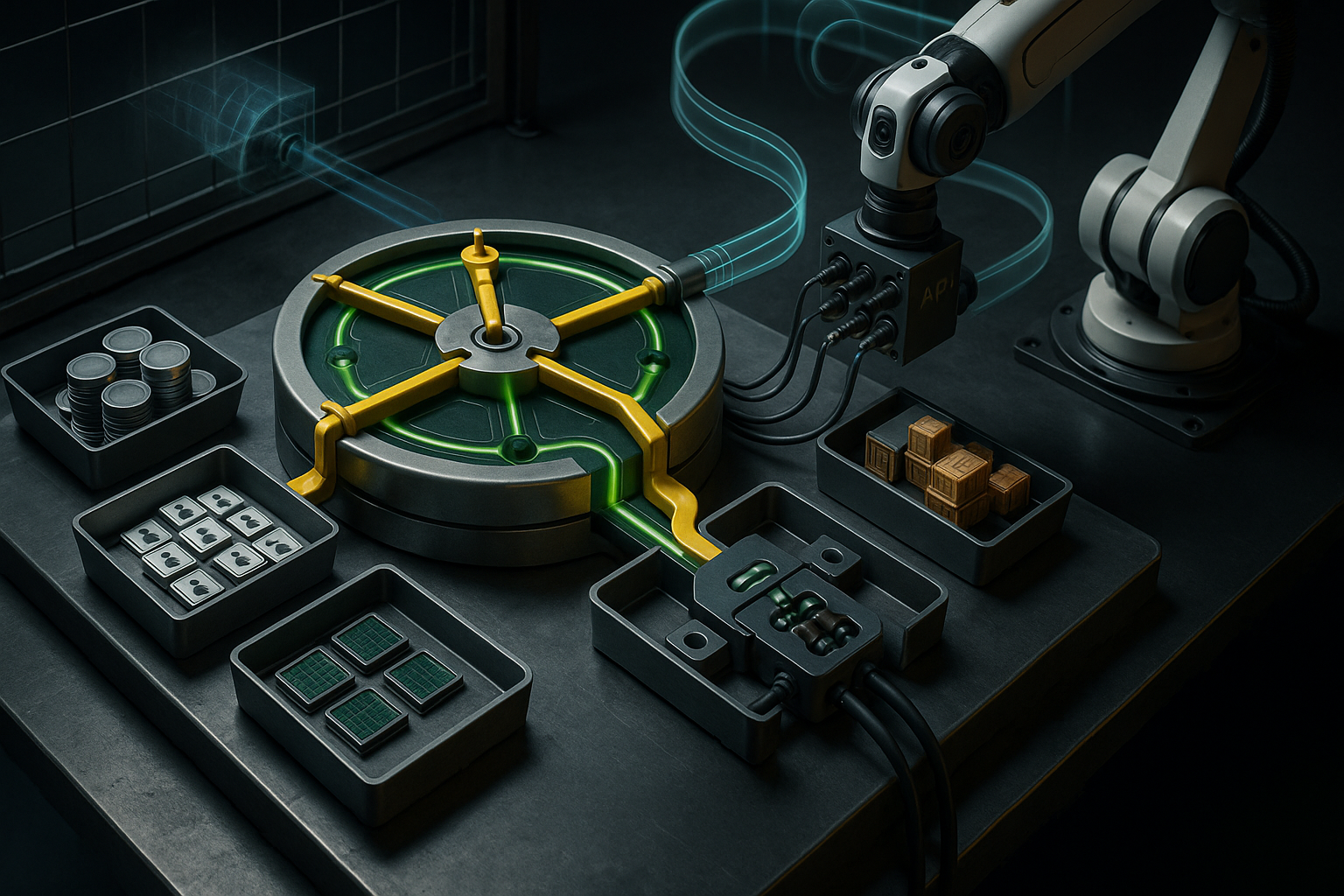
The useful framework is a capital router: a system for deciding where money, talent, executive attention, and product risk should move when AI demand changes the shape of a market.
First, route capital toward bottlenecks, not slogans. Cisco is emphasizing silicon, optics, security, and AI-enabled work because those are closer to where demand is tightening. For other companies, the bottleneck may be data rights, customer support capacity, compliance review, integration engineering, or inference cost. The principle is the same: spend where AI creates constraint, not where it creates the best press release.
Second, separate orders, revenue, and operating leverage. AI infrastructure orders are a strong signal, but operators should still ask how backlog converts, what margins look like under component shortages, and whether customers are buying a repeatable platform or a one-time buildout. A demand spike is not the same as a durable operating model.
Third, make restructuring explicit. Cisco's workforce cut is not evidence that "AI replaced 4,000 jobs." The sourced claim is narrower: Cisco is reducing roles while shifting investment toward AI-era growth areas. That distinction matters. Leaders should not hide ordinary cost cutting behind AI language, but they also cannot keep every old org shape when demand moves.
Fourth, protect the customer promise. The danger in any AI reallocation is cutting the people who understand the legacy systems customers still depend on. Infrastructure companies win by compounding trust. If headcount reduction slows support, migration, security response, or integration work, the capital router is mispriced.
Fifth, measure internal AI as operating capacity. Cisco's CEO note specifically mentioned employees' use of AI. That should be tracked like an operating system upgrade: cycle time, support resolution, test coverage, incident response, sales engineering throughput, and customer satisfaction. Usage leaderboards are weak. Process-level throughput is stronger.
What Operators Should Do
Map the AI demand chain in your own business. Where does AI create the next hard constraint: compute, memory, network, data, quality review, legal approval, onboarding, support, or trust?
Label each constraint as buy, build, automate, partner, or stop. A company cannot automate its way out of every bottleneck, and it should not hire around every broken process.
Create a conversion dashboard. Track the path from AI interest to committed order, shipped product, revenue, gross margin, support load, and renewal risk. This prevents AI demand from becoming a vanity metric.
Audit the roles being cut and the capabilities being funded. The question is not whether headcount goes down or up. The question is whether the company is moving capacity from low-leverage work into the bottlenecks that decide customer value.
Build the trust layer before the growth layer breaks. AI infrastructure customers care about performance, but they also care about supply certainty, security, observability, and accountability. Cisco's emphasis on security and optics is a reminder that the sale is not only speed. It is dependable capacity.
The Takeaway
Cisco's quarter shows the next phase of AI infrastructure competition. The winners will not be the companies that say "AI" most often. They will be the companies that can reroute capital toward the scarce parts of the stack while preserving the customer trust that made them relevant in the first place.
AI demand is real. The harder question is whether a company can turn that demand into a sharper operating model.
Sources
- https://newsroom.cisco.com/c/r/newsroom/en/us/a/y2026/m05/cisco-reports-third-quarter-earnings.html
- https://blogs.cisco.com/news/our-path-forward
- https://www.networkworld.com/article/4171043/cisco-to-cut-nearly-4000-jobs-despite-strong-growth-in-ai-enterprise-networking.html
- https://www.marketscreener.com/news/cisco-announces-restructuring-plan-raises-annual-revenue-forecast-ce7f5bdcdf8aff2c