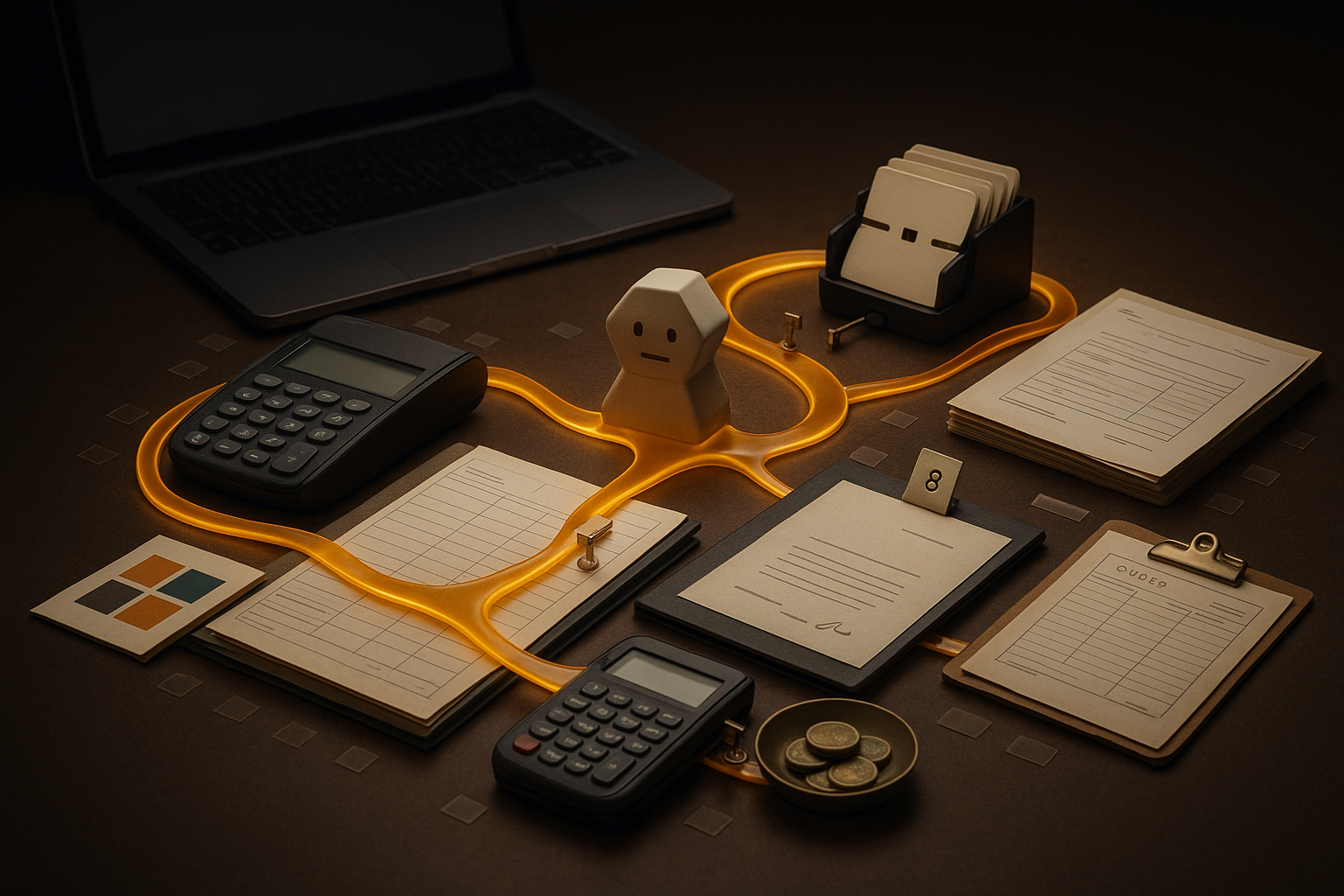
Anthropic's new small-business launch is easy to misread as another AI product bundle. The sharper signal is where the company is placing Claude: inside the messy operating tools that small businesses already use to manage money, customers, contracts, documents, and campaigns.
Claude for Small Business, announced May 13, runs through Claude Cowork. Anthropic says it can connect to Intuit QuickBooks, PayPal, HubSpot, Canva, DocuSign, Google Workspace, and Microsoft 365. It ships with 15 ready-to-run agentic workflows and 15 skills across finance, operations, sales, marketing, HR, and customer service.
The thesis: the next useful agent market is not a blank chat window. It is a permissioned operations layer across the tools where work already happens.
The Real Signal
Small businesses do not usually have AI transformation teams. They have owners, managers, bookkeepers, sales leads, and operations people who already live inside a stack of disconnected software. If an AI tool requires them to become prompt engineers, adoption stalls at experimentation.
Anthropic's move is an attempt to package agents as repeatable business work. The launch examples are not abstract productivity claims. They are jobs: plan payroll, reconcile the month, chase invoices, surface cash position, run a campaign, review contracts, triage leads, prepare tax-season materials, and turn business data into a close packet.
That matters because small-business AI adoption is likely to be won through operational specificity. A local services firm does not need a general-purpose assistant that can explain strategy. It needs a system that can look across payments, accounting, CRM, docs, and design tools without creating chaos.
The Small-Business Agent Stack
The useful framework is a five-layer stack.
First, workflow packaging. Agents need named jobs, not infinite possibility. "Close the month" is more adoptable than "ask Claude anything." Packaging narrows the task, sets expectations, and makes success easier to evaluate.
Second, connector surface. Anthropic's initial list is instructive: QuickBooks for financial records, PayPal for payments and disputes, HubSpot for customer context, Canva for marketing assets, DocuSign for contracts, and Google Workspace and Microsoft 365 for everyday work. The agent is valuable because it crosses systems.
Third, permission inheritance. Anthropic says existing account permissions carry through, so an employee cannot use Claude to see something the connected account would not already allow. That is not a minor feature. For small businesses, trust depends on whether AI respects the same boundaries as the software stack.
Fourth, human approval. Anthropic says users approve before anything sends, posts, or pays. This keeps the system closer to supervised operations than autonomous execution. That distinction matters. Many small businesses will accept AI that prepares, checks, drafts, and queues work before they accept AI that spends money or contacts customers on its own.
Fifth, training and trust. Anthropic is pairing the product with an AI fluency course and a 10-city tour beginning May 14. Each stop is planned as a half-day workshop for 100 local small-business leaders. That is go-to-market design, not just education. The product needs owners to trust the workflow before the workflow can become habit.
What Operators Should Copy
The lesson for software teams is not to bolt an AI button onto every screen. The lesson is to find the recurring job that already spans multiple tools, then make the AI path faster and safer than the manual path.
Good candidates have three traits.
They happen often enough to hurt: invoice follow-up, lead qualification, payroll prep, month-end reporting, contract routing, customer support handoff, campaign assembly, and inventory review.
They require context from more than one system. A single-app assistant can summarize a page. A useful operations agent can connect the payment status, customer record, contract, email thread, and next action.
They need an approval point. The highest-trust design is often not full automation. It is a prepared decision with evidence, proposed action, and a clear "send," "post," "pay," or "file" moment.
That is the agent product pattern: narrow job, broad context, visible controls.
The Founder Opportunity
Anthropic's launch also exposes room for specialists.
Small businesses will not all run on the same seven connectors. Vertical agents can win by understanding industry-specific systems: field-service dispatch, dental practice management, contractor estimating, restaurant scheduling, insurance agency workflows, franchise reporting, clinic intake, property management, local logistics, and trade-specific compliance.
There is also a trust layer opportunity. Owners will need audit trails, permission maps, redaction, vendor-term summaries, approval logs, and easy rollback when an agent touches financial or customer data. The companies that make agent use governable for small teams may become more important than the companies that only provide raw model access.
The strongest wedge is not "AI for small business" as a slogan. It is one painful workflow with the right connectors and the right control points.
The Takeaway
Claude for Small Business is a bet that AI agents move from demo to daily use when they become operations glue. The product still has to prove adoption, reliability, and trust. But the direction is right: agents become useful when they are packaged around real work, connected to real systems, constrained by permissions, and reviewed by the people accountable for the outcome.
For operators, the question is which workflows deserve this treatment first. For founders, the opening is to build the industry-specific layers that general platforms will not cover deeply enough. For investors and strategists, the signal is that the AI platform race is moving from model capability into workflow distribution.
The blank chat window was the first interface. The next one looks more like a governed back office.
Sources
- https://www.anthropic.com/news/claude-for-small-business
- https://www.axios.com/2026/05/13/anthropic-claude-small-business-smb
- https://techcrunch.com/2026/05/13/anthropic-courts-a-new-kind-of-customer-small-business-owners/
- https://www.theregister.com/ai-ml/2026/05/13/anthropic-butts-in-to-small-business-promises-help-with-payroll-and-other-core-tasks/5239967