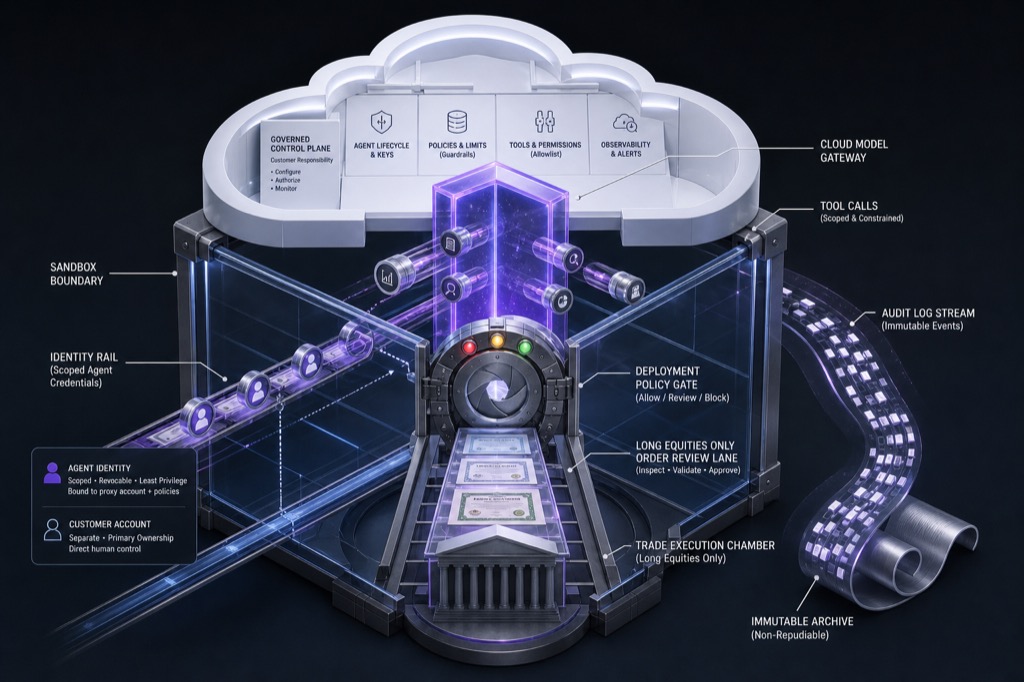
Robinhood's agentic trading launch is not just another finance chatbot. It is a test of whether consumer AI agents can be given real authority without turning regulated workflows into a black box.
The product is concrete. Robinhood says users can connect a third-party AI agent to a dedicated Robinhood Agentic account through the Robinhood Trading MCP. The agent can inspect account data, read positions and balances, review orders, and place trades. At launch, Robinhood's own support page says the trading scope is long equities only.
The thesis: the next serious AI-agent products will be judged less by how smart the model sounds and more by how clearly the control plane limits what the agent can do.
The Control-Plane Test
For operators, Robinhood's move is useful because it exposes the real checklist for high-consequence agents.
1. Identity and authority
An agent should not be an invisible overlay on a customer's main account. Robinhood is using a separate Agentic account, described as a self-directed individual investing account. Customers connect the agent through the Robinhood Trading MCP and authenticate the setup.
That matters because agent authority needs a container. If an agent can act, the product must define which account it acts through, who authorized it, and where its activity is recorded.
2. Tool scope
Robinhood publishes the current tool surface: account lookup, portfolio snapshots, positions, quotes, order history, tradability checks, order review, order placement, cancellation, and ticker search.
That is more useful than saying "AI can trade." It tells builders what the agent is allowed to touch.
The current limit is also important: long equities orders only. Reuters reported that Robinhood expects to expand to derivatives, crypto, and prediction markets, but those are not the same risk class. Every new asset type changes the control problem.
3. Money boundaries
Reuters reported that Robinhood is also enabling agentic credit card purchases through a virtual Robinhood Gold card, with spending limits and optional manual approval before purchases.
That is the commerce version of the same pattern. The practical question is not whether an agent can buy something. It is whether the system can cap spend, isolate credentials, require approval, cancel access, and explain what happened afterward.
4. Review and audit
Robinhood says orders will appear in the Agentic account Activity section and in Robinhood history. Its tool surface includes an order-review call that can simulate an equity order and return pre-trade warnings.
This is where agent products become operational systems. A review step is not just a UX nicety. It is the difference between an instruction becoming a proposal and an instruction becoming an execution.
5. Responsibility language
The sharpest part of Robinhood's documentation is the risk section. The company says users are responsible for trades placed by their AI agents, agents may execute trades without direct input on each transaction if configured that way, and agents can make errors or act on incomplete information.
That is not marketing copy. It is the boundary condition for the product. In regulated domains, the legal and operational model is part of the customer experience.
Why This Matters Now
Robinhood has enough distribution for this experiment to matter. In Q1 2026, the company reported 4.3 million Gold subscribers, nearly 1 million customers using Cortex Digests to date, more than 800,000 funded Gold Card customers, $638 billion in quarterly equity notional trading volume, and a $17.0 billion margin book.
Those numbers do not prove agentic trading will work. They explain why the launch is worth watching. A consumer fintech with trading volume, card distribution, and an existing AI surface is moving agents from advice into controlled execution.
For fintech builders, the lesson is not "let agents trade." The lesson is that agentic finance is a permissions product before it is an intelligence product.
What Builders Should Copy
Use Robinhood's launch as a design checklist:
- Put the agent in a scoped account or workspace.
- Publish the exact tool calls the agent can use.
- Start with a narrow asset or action class.
- Add review steps before irreversible execution.
- Make activity visible in a durable history.
- Give users limits, cancellation, and approval controls.
- Say plainly who is responsible when the agent acts.
That pattern applies beyond brokerage. Healthcare agents, procurement agents, travel agents, insurance agents, and enterprise finance agents all need the same architecture: identity, scope, limits, review, audit, and accountability.
The Takeaway
Robinhood's agentic trading launch is a signal that AI agents are entering the execution layer. The moat will not be a prettier chat box. It will be the permission system around the agent.
The best agent products will feel less like magic and more like well-instrumented machinery: narrow enough to trust, visible enough to inspect, and bounded enough to stop.
Sources
https://robinhood.com/us/en/support/articles/agentic-trading-overview/
https://robinhood.com/us/en/support/articles/trading-with-your-agent/
https://techcrunch.com/2026/05/27/robinhood-now-lets-your-ai-agents-trade-stocks/
https://investors.robinhood.com/static-files/15576d76-2d02-4aea-a40d-48e694c04a4b