Amazon's new Proteus robot is easy to read as another warehouse automation story. That misses the more useful signal.
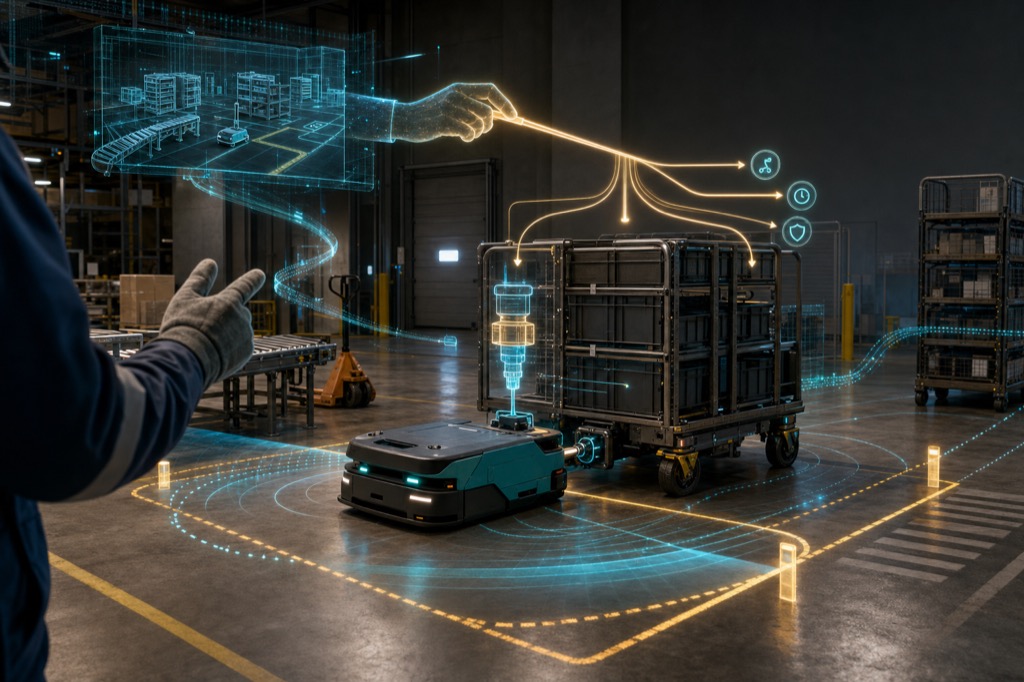
The real move is not just a better mobile robot. It is a shift toward a command layer for physical work: an employee gives an intent in natural language, and the system turns that request into priority, route, timing, and movement.
The thesis: physical AI is becoming less about isolated robot skills and more about operational commands that software can safely translate into work.
The Move
On June 4, Amazon announced a next-generation version of Proteus, its autonomous mobile robot for fulfillment operations. The current Proteus operates in dock areas at 25 U.S. fulfillment centers and moves heavy carts that can weigh close to 400 kilograms.
The new version is designed to go wider. Amazon says it can work anywhere items need to be moved across fulfillment centers and delivery sites, including container transport, transfers between workstations, and broader material movement.
The interface change matters most. Instead of technical commands or a programming interface, employees will be able to direct Proteus with plain conversational language. Amazon's example is simple: tell it what needs to be done, and the robot figures out priority, route, and timing.
The robot is still in Amazon's labs. Deployment in Europe is planned for the first half of 2027. It sits inside a larger European operations push: more than EUR10 billion for fulfillment modernization, 25,000 planned European fulfillment roles, STARK expanding to 15 European sites by 2027, and a $1 billion Career Choice commitment by 2030.
The Command Layer Framework
The useful way to understand Proteus is not "robot replaces worker." It is "robot becomes commandable infrastructure."
That command layer has four parts.
1. Intent Capture
Natural language is not valuable because it feels futuristic. It is valuable because warehouses are full of local, situational requests: move these containers, clear this workstation, stage this cart, rebalance this flow, handle this exception.
If workers need to stop and encode every request into a rigid interface, robot utilization stays narrow. If the system can understand operational intent, the robot can move closer to the actual rhythm of the floor.
2. Task Translation
The hard step is not hearing the sentence. It is translating that sentence into a safe, executable task.
That means grounding the request in inventory state, facility layout, robot availability, route constraints, worker proximity, timing windows, and priority rules. A warehouse robot that understands language still needs a planner, a policy layer, and a live operating model of the site.
3. Fleet Orchestration
One commandable robot is useful. A fleet of commandable robots is an operations system.
This is where the founder opportunity lives. Logistics operators will need software that turns human requests into robot jobs, schedules those jobs across mixed fleets, logs decisions, handles exceptions, and explains why a robot took one route or priority over another.
The winners will not only build better robots. They will build the translation layer between human intent and machine execution.
4. Work Redesign
Natural-language robotics only helps if the surrounding work is designed for it.
Operators should ask which tasks are frequent, physical, measurable, interruptible, and safe to delegate. "Move this cart" is a better starting point than "run the warehouse." The right unit of automation is a commandable work package, not an entire job title.
Why This Matters Now
Supply Chain Dive recently framed warehouse robotics as a software-plus-hardware problem, not a hardware purchase alone. It cited PwC research saying 57% of surveyed operations and supply-chain leaders had integrated AI in some form, including warehouse robotics strategy.
Amazon's Proteus update is a concrete example of that shift. The robot matters, but the bigger system is software-directed work: sensing, planning, routing, safety, exception handling, and human instruction.
For operators, this suggests a practical roadmap. Start by mapping physical workflows into repeatable commands. Define what a safe instruction looks like. Capture exceptions. Decide where human approval is required. Measure whether robots are reducing bottlenecks, not just whether they are moving.
For founders, the opening is not another generic warehouse dashboard. It is the command layer around physical AI: natural-language task intake, policy-constrained planning, real-time fleet state, simulation before execution, audit trails, and interfaces for nontechnical floor leaders.
For public-company watchers, the useful read is strategic rather than promotional. Amazon is linking AI robotics to a large operations investment, workforce growth claims, upskilling, delivery expansion, and fulfillment modernization. That does not prove financial payoff. It does show where a major operator believes the next automation interface belongs: between people who know the work and robots that can move through it.
The Takeaway
Proteus is not a humanoid spectacle. It is more interesting than that.
It points to a near-term version of physical AI where workers do not program robots; they assign work. The competitive layer becomes the system that can turn those assignments into safe, measurable, explainable execution.
The next robotics market will not be won only by machines that move better. It will be won by systems that understand what work should happen next.
Sources
https://www.aboutamazon.com/news/operations/amazon-proteus-robot-europe-investment-employee-support
https://www.aboutamazon.com/news/operations/amazon-europe-robotics-delivery-investment
https://www.supplychaindive.com/news/warehouse-robotics-implementation-ai-software/816122/