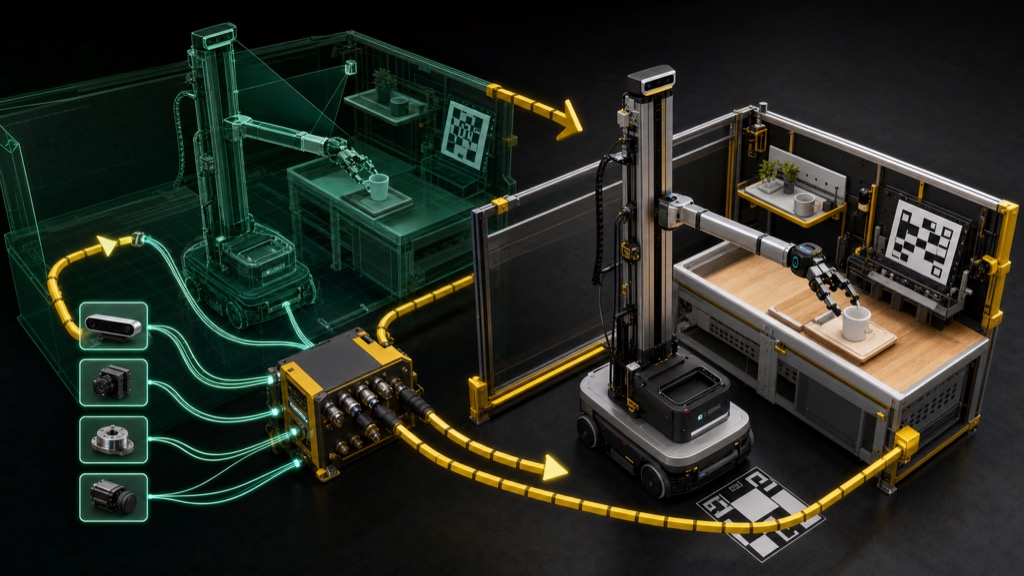
The most interesting home robot story right now is not a humanoid walking through a demo room. It is a tall, narrow mobile manipulator that costs $29,950, ships with open-source software, and is built around jobs like retrieving objects, assisting routines, collecting data, and letting researchers test physical AI in real rooms.
The thesis: Hello Robot's Stretch 4 is a signal that practical physical AI will commercialize through task-shaped platforms before it arrives as general-purpose home labor.
The Move
Hello Robot announced Stretch 4 in May. The company describes it as an open-source mobile manipulation platform for researchers, developers, and application engineers building physical AI. Its own product page lists ROS 2 and Python SDK support, out-of-the-box calibration, reference demos for autonomy and embodied AI, and a hardware profile designed for homes and workplaces rather than a stage.
The specs matter because they make the strategy concrete. Stretch 4 lists 55 cm plus 6 cm of wrist reach, 2.5 kg payload with the arm extended, 4 kg with the arm retracted, 8 hours of runtime under light CPU load, and a 160 cm height with a 45 cm diameter footprint.
That is not a sci-fi promise. It is a bounded machine for bounded work.
Independent reporting makes the use case sharper. TechCrunch described a Stretch user directing the robot through a voice-operated iPhone app, sending it autonomously to a location, and then taking direct control for manipulation. AP reported on a Stretch 4 deployment in a New Hampshire home for reminders, guided exercise, prompts, and support for daily routines.
The useful signal is the stack, not the spectacle.
The Useful Robot Stack
Stretch 4 points to a four-layer commercialization model for physical AI.
1. A Practical Body
Humanoid shape creates huge expectations. It also creates hard safety, cost, reliability, and dexterity problems.
Stretch takes the opposite path: a mobile base, a telescoping arm, a gripper, sensors, and developer-accessible software. The bet is that a robot does not need to look human to create value. It needs to reach, move, see, stop safely, and execute repeatable tasks in cluttered spaces.
For operators, that changes the evaluation question. Do not ask whether a robot can do everything a person can do. Ask whether it can perform one painful physical workflow reliably enough to justify a pilot.
2. An Open Developer Surface
Physical AI is still too early for closed, finished appliances to cover every useful workflow. Homes, labs, health settings, and workplaces vary too much.
That makes the SDK and developer community part of the product. ROS 2, Python, demos, documentation, simulation, data collection, and teleoperation are not secondary features. They are how a robot becomes adaptable enough for real applications.
The near-term buyer is not just a consumer. It is a researcher, care organization, robotics team, enterprise partner, or founder building a workflow on top of the hardware.
3. Human-in-the-Loop Control
The smartest design choice may be admitting where autonomy should stop.
A voice instruction can send the robot to a place. Direct control can handle manipulation. Sensors and onboard intelligence can help with perception. That hybrid pattern is more believable than a promise of fully autonomous home labor.
The pattern is: navigate autonomously, assist intelligently, escalate to human control when dexterity or judgment gets hard.
That is how many useful physical AI products will start. Not with full autonomy, but with autonomy wrapped around human agency.
4. Workflow Packaging
The real product opportunity is not "a robot in the home." That is too broad.
The product opportunity is a packaged workflow: retrieve a drink, support a morning routine, provide exercise prompts, inspect a remote site, collect manipulation data, assist telehealth, or handle a narrow workplace task.
Founders should pay attention here. Hardware alone is rarely the wedge. The wedge is a specific job, a measurable outcome, a support model, and a buyer who already feels the pain.
Why This Matters Now
The physical AI market is splitting into two stories.
One story is the humanoid race: big ambition, high burn, difficult safety cases, and long timelines. The other is a quieter platform race: machines that can perform constrained work soon, while developers and operators build the application layer around them.
Stretch 4 belongs to the second story. That does not make it small. It makes it testable.
For operators, the lesson is to scope physical AI around repeatable work packages. The first useful question is not "Can this replace labor?" It is "Which task is frequent, safe, physical, measurable, and annoying enough to automate or augment?"
For founders, the opening is workflow software and services around useful robots: teleoperation interfaces, care protocols, remote monitoring, field deployment, robot data pipelines, integration with existing devices, and compliance-ready pilot programs.
For investors and market watchers, the signal is discipline. A $29,950 robot with an open platform and visible assistive workflows is not proof of mass adoption. It is evidence that physical AI can move from demos into constrained, source-backed use cases where the work is specific enough to evaluate.
The Takeaway
The first useful home robots may not arrive as all-purpose humanoids. They may arrive as practical platforms with modest bodies, strong developer surfaces, human-in-the-loop controls, and narrow workflows that matter deeply to the people using them.
That is the useful home robot stack: body, software, human control, workflow.
Builders should stop asking when a robot can do everything. The better question is which physical job can be made useful enough, safe enough, and repeatable enough right now.
Sources
https://forum.hello-robot.com/t/introducing-stretch-4/1505