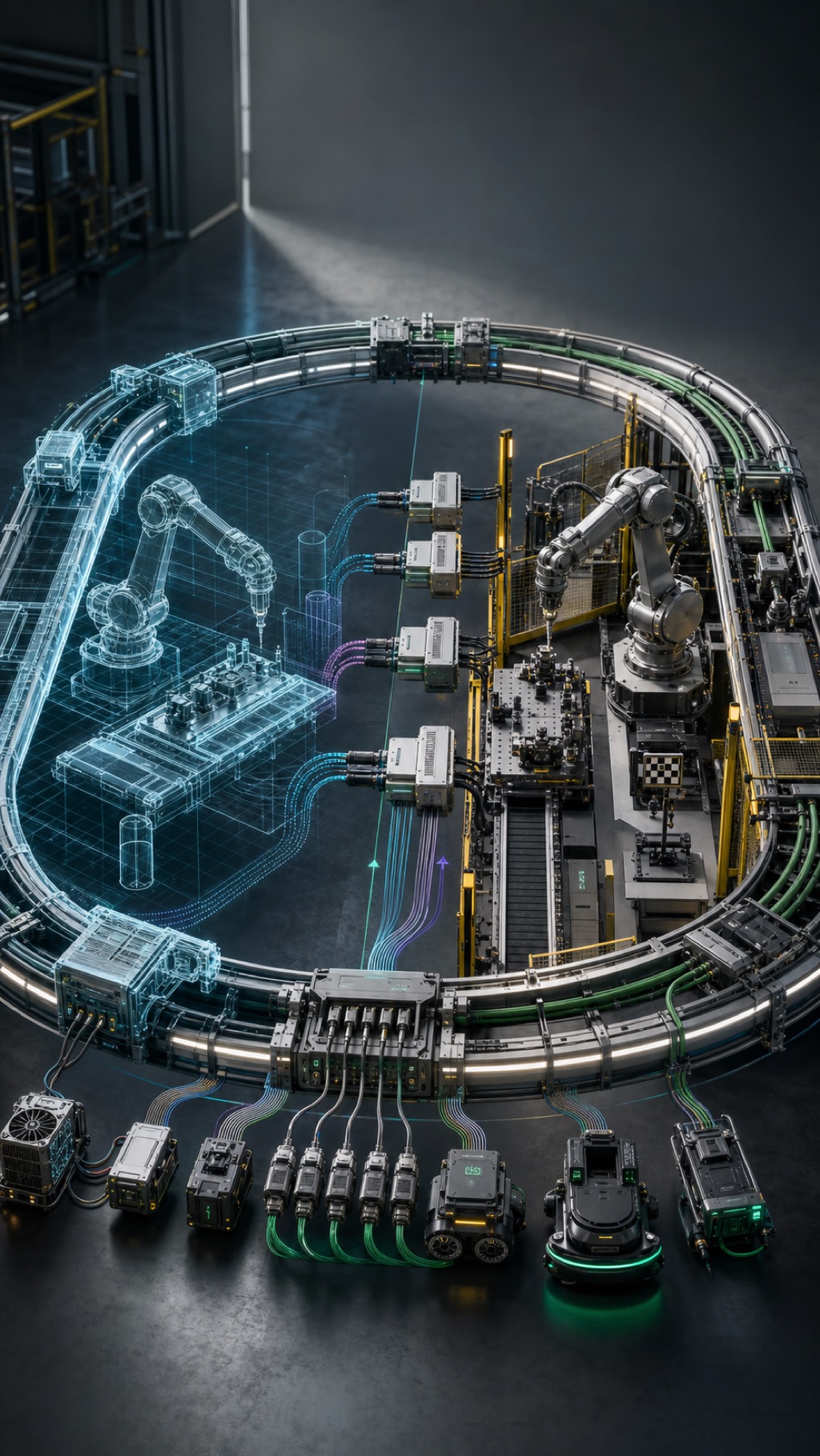
LG's new NVIDIA collaboration is easy to misread as another robotics announcement. It is more useful to read it as an integration map.
NVIDIA says it and LG Group are building an AI factory to support robotics, autonomous driving, data-center technologies and GPU cloud services. LG's own announcement adds the operating shape: reference robots, autonomous manufacturing, AI infrastructure, mobility systems and EXAONE all sit inside the same strategic partnership.
The thesis is simple: physical AI will not be won by the best robot demo alone. It will be won by whoever connects models, data, simulation, factory operations, power, cooling, mobility compute and enterprise workflow into one deployable system.
Why This Matters Now
The companies announced the expanded partnership around a June 8 executive meeting in Seoul between LG Corp CEO Koo Kwang-mo, NVIDIA CEO Jensen Huang and other senior leaders.
The scope is unusually broad. LG Electronics is integrating NVIDIA Isaac Sim and Isaac Lab into home-robot development workflows and exploring Isaac GR00T for home robots and modular robotics platforms. LG is also developing a physical AI data factory using NVIDIA Cosmos world foundation models to generate and augment robotics and industrial AI training data.
The industrial side matters just as much. LG CNS plans to integrate Isaac, Cosmos and Isaac GR00T into PhysicalWorks, its industrial robot platform for manufacturing and logistics sites. LG Innotek is positioned around sensing and optical components. LG Uplus and LG CNS plan DSX-aligned AI factories. LG Energy Solution is discussing 800-volt direct-current data-center power solutions aligned with NVIDIA battery energy storage guidance.
Reuters independently reported that Huang said NVIDIA is working with LG on humanoid robots, motor technology, mechanical systems and future data centers.
This is not a narrow toolchain. It is a conglomerate-level attempt to connect the physical AI stack.
The Integration Layer
Operators should watch five layers.
First, the robot layer. Home robots, humanoid systems and logistics robots need perception, motion, reasoning and safe task execution. Isaac Sim, Isaac Lab and GR00T point to development before deployment, not just hardware after launch.
Second, the data layer. A physical AI data factory is important because robotics teams run into a training-data bottleneck fast. Synthetic data does not remove the need for real-world validation, but it can make simulation, edge-case generation and workflow rehearsal more systematic.
Third, the manufacturing layer. LG says the companies want an autonomous manufacturing ecosystem where procurement, production, logistics and customer delivery are connected through data and AI in real time. That is the right level of ambition: physical AI becomes valuable when it changes a workflow, not when it performs a lab trick.
Fourth, the infrastructure layer. AI factories need thermal and power design. NVIDIA's post names cooling distribution units, cold plates and prefab modular design. LG's release adds DSX AI Factory architecture and 800V DC data-center power collaboration. Serious AI deployment now forces hardware, facilities and energy planning into the same room.
Fifth, the model layer. LG AI Research used Blackwell GPUs, NeMo, Nemotron datasets and TensorRT-LLM to support EXAONE development and inference optimization. That links the partnership back to sovereign and enterprise AI, not only robots.
The Operator Lesson
The mistake is buying physical AI as a device category.
The better question is whether a company can operate the loop:
- Can it generate and validate task data?
- Can it simulate before real-world deployment?
- Can it move from home robots to logistics and manufacturing without rebuilding the stack each time?
- Can the data center support the thermal, power and GPU requirements?
- Can internal AI models and enterprise agents plug into the same operating system?
LG already had the strategic reasons to care. In January, LG said future-growth investment would rise by more than 40 percent year over year, focused on AI Home, smart factories, AI data-center cooling and robotics. It also said its smart factory solutions business recorded KRW 500 billion in orders last year.
Those numbers do not prove the NVIDIA partnership will work. They do show why LG is not treating AI as a software feature alone. It is trying to turn AI into a portfolio operating layer.
For founders, the opportunity is in the gaps: robotics data QA, simulation operations, deployment monitoring, energy-aware AI infrastructure, factory digital-twin services, robot fleet safety review and integration middleware for industrial buyers.
For operators, the buying standard should change. Ask less about the robot's most impressive demo and more about the system around it: data, simulation, deployment, power, cooling, monitoring, failure handling and workflow ownership.
LG and NVIDIA have not published commercial outcomes from this AI factory yet. The announcement is a roadmap, not proof of scale. But the roadmap is a useful signal.
Physical AI is becoming an integration problem. The winning teams will not just build smarter machines. They will build the operating layer that lets those machines train, deploy, adapt and survive inside real businesses.