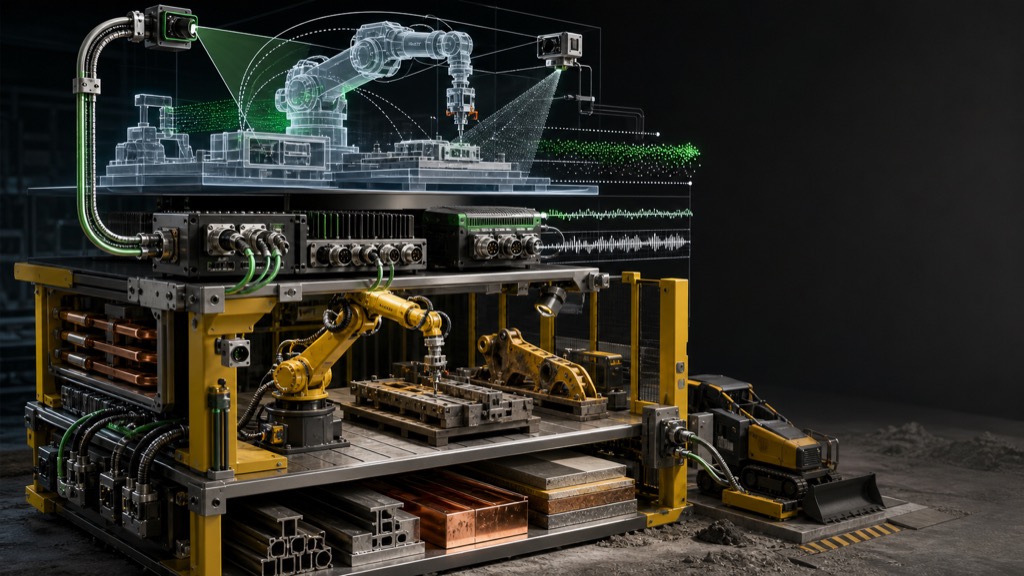
Physical AI is becoming less interesting as a robot demo and more interesting as an industrial stack.
NVIDIA and Doosan Group's expanded collaboration matters because it connects pieces that are usually discussed separately: robot software, simulation, edge inference, construction equipment, power infrastructure and advanced materials for AI data centers. That is the real signal. The companies are not only talking about smarter robots. They are mapping how physical AI might plug into factories, job sites, power systems and the infrastructure that keeps AI factories running.
The thesis is simple: physical AI will not scale as a single-product story. It will scale as a stack.
Why This Matters Now
NVIDIA announced the collaboration on June 7, and Doosan followed with its own announcement on June 8. The scope spans four Doosan units: Doosan Robotics, Doosan Bobcat, Doosan Enerbility and Doosan Corporation Electro-Materials BG.
Doosan Robotics is integrating NVIDIA Isaac Sim, Isaac Lab, Cosmos, the Newton physics engine and Jetson Thor into its Agentic Robot OS. The companies name industrial tasks such as depalletizing and sanding, plus future dual-arm and humanoid platforms. Doosan Bobcat is exploring physical AI for equipment used in construction, landscaping, agriculture and material handling.
The infrastructure side is just as important. Doosan Enerbility is exploring power support for NVIDIA AI factories through gas turbines, steam turbines, small modular reactors and hydrogen fuel-cell systems. Doosan Corporation Electro-Materials BG is looking at copper clad laminate materials for printed circuit boards used in AI accelerators, networking equipment and AI server motherboards. Doosan says a new Thailand facility for advanced CCL capacity is scheduled to begin mass production in 2028.
Aju Press independently reported the announcement as part of Jensen Huang's Seoul trip and noted that the collaboration spans robotics, heavy equipment, energy and PCB materials. That context matters because NVIDIA is not positioning physical AI as a narrow robotics push. It is building an ecosystem around industrial execution.
The Stack To Watch
Operators should evaluate physical AI in five layers.
First, the robot runtime. A robot arm or machine needs perception, reasoning, control and on-device inference. That is where Agentic Robot OS and Jetson Thor become more than product names. They are the control layer.
Second, the simulation loop. Isaac Sim, Isaac Lab, Cosmos and Newton point to the same operational need: train, test and calibrate physical behavior before the machine hits a real floor, site or field.
Third, the workflow target. Depalletizing and sanding are useful examples because they are specific. Vague autonomy claims are easy. A named industrial task forces the system to handle materials, constraints, safety rules, cycle time and quality.
Fourth, the energy layer. AI factories need continuous power, and physical AI increases demand for compute, simulation and edge deployment. Power design becomes part of AI infrastructure strategy, not a facilities afterthought.
Fifth, the materials layer. High-performance AI servers depend on signal integrity, reliable boards and scalable supply. Copper clad laminate is not flashy, but it sits underneath the bandwidth and reliability AI infrastructure needs.
The Operator Lesson
The mistake is treating physical AI as a hardware race.
The better question is whether the stack can close the loop from simulation to deployment. Can the system learn in simulation, move inference to the machine, adapt to messy environments, support the energy load and rely on a supply chain that can scale?
For founders, the opportunity is in the gaps between layers: task-specific simulation tooling, robot workflow QA, fleet monitoring, edge model deployment, safety validation, equipment-specific world models and integration services for industrial buyers.
For operators, the buying checklist should be concrete:
- What exact workflow is being automated?
- Which simulation tools prove it before deployment?
- What runs on-device versus in the cloud?
- How does the system handle failure, drift and safety review?
- What power and infrastructure assumptions does the rollout require?
- Which supply-chain dependencies could slow scale?
NVIDIA and Doosan have not proven commercial outcomes from this collaboration yet. The announcements are still a roadmap, not a deployment receipt. But the shape of the roadmap is useful.
Physical AI is moving from "watch the robot move" to "show the industrial system around the robot." The teams that understand that shift will evaluate robotics less by demo choreography and more by runtime, simulation, workflow, power and materials.
That is where the next serious physical-AI advantage will be built.