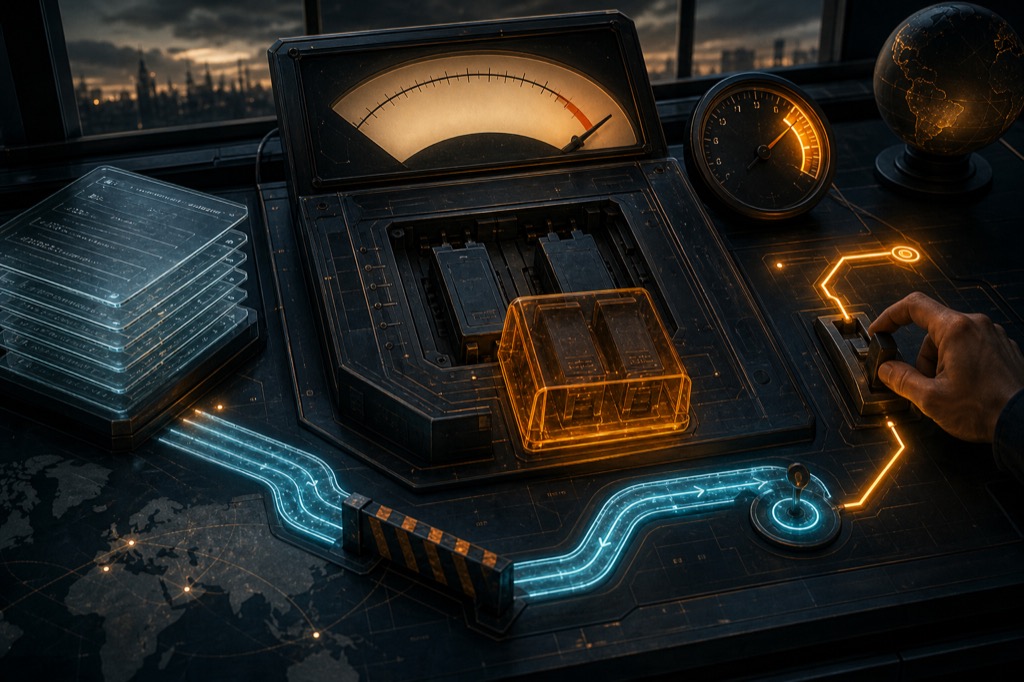
Anthropic's Fable 5 and Mythos 5 shutdown is not only a policy fight. It is a product architecture warning.
The company launched Claude Fable 5 and Claude Mythos 5 on June 11. Anthropic listed both models at $10 per million input tokens and $50 per million output tokens, positioned Fable 5 for broad use, and described Mythos 5 as a more restricted trusted-access model for cyberdefenders and infrastructure partners.
One day later, Anthropic said the US government issued an export-control directive requiring the company to suspend access to both models for any foreign national, inside or outside the United States, including foreign-national Anthropic employees. Because Anthropic could not comply cleanly at that granularity, it said it had to disable both models for all customers. Other Anthropic models were not affected.
The thesis is simple: frontier model access is becoming a reliability layer. Teams cannot treat a named model as a permanent utility just because the API worked yesterday.
The New Failure Mode
Most AI reliability plans cover familiar failures: latency spikes, rate limits, vendor outages, pricing changes, context-window limits, model regressions and safety refusals.
The Fable/Mythos episode adds a different class: policy interruption.
The Verge reported that experts saw the move as an unsettled export-control precedent because hosted AI services do not fit neatly into the older model of shipping hardware, source code, software, technical data or model weights across borders. Axios reported that Anthropic had 90 minutes to take the models down after Amazon raised concerns with US officials about a jailbreak that could bypass Fable guardrails.
Those details matter less as political theater than as operating evidence. A model can become unavailable because an outside authority changes the permissible access boundary. That is a different risk from a vendor outage. It can arrive quickly, affect customers unevenly, and leave product teams explaining a dependency they do not control.
The Operator Lesson
The wrong lesson is "never use frontier models." The right lesson is "do not bind critical workflows to one irreplaceable model name."
If a model powers drafting, code review, support triage, security analysis, finance research or scientific workflows, access continuity needs an owner. That owner should know which workflows require the top model, which can fall back to a lower-tier model, which need human review, and which must stop rather than degrade.
This is not theoretical multi-cloud theater. It is a workflow map.
First, separate capability tiers from vendor names. The system should know whether a task needs frontier cyber reasoning, long-horizon coding, ordinary summarization or structured extraction. Then each tier can have approved substitutes.
Second, create jurisdiction and user-class rules. If access changes for certain nationalities, regions, sectors or customer types, the product needs a policy table rather than an emergency Slack thread.
Third, prewrite degradation behavior. Customers should see a clear message, a safe fallback, a queue for later execution or a human escalation path. Silent quality drops are worse than honest reduced capability.
Fourth, log model dependency by workflow. If a provider change breaks something, the team should know which customers, jobs, prompts and outputs were exposed.
The Founder Opening
There is a product opportunity here: AI access continuity infrastructure.
The useful layer is not just a router that swaps between models by price. It is a reliability and policy control plane for AI workflows. It should track model capability, contractual terms, jurisdictional constraints, safety posture, customer entitlements, audit logs and fallback rules.
The product promise is not "avoid regulation." It is "make model access governable."
Enterprise buyers will increasingly ask harder questions: What happens if a model is withdrawn? Can another model take over? Which outputs were generated by the restricted system? Can we prove a regulated customer did not use a prohibited capability? Can we pause one workflow without shutting down the entire product?
Those are boring questions until the model disappears. Then they become the roadmap.
The Investor Lens
For market watchers, the signal is that frontier-model capability can create both pricing power and intervention risk. Anthropic's launch page shows why customers wanted the models: advanced cyber, coding, knowledge-work and life-science capabilities, priced for API consumption. The next-day directive shows the other side of that power. The more strategically important a model becomes, the more likely access rules become part of the business model.
That does not make frontier labs uninvestable or unusable. It means platform risk deserves the same attention as benchmark performance, enterprise adoption, compute cost and gross margin.
The Takeaway
The Fable/Mythos disruption turns one buried assumption into an explicit architecture requirement: model access is not guaranteed just because the provider is strong.
AI teams should now maintain a model-access reliability plan:
- capability tiers
- approved substitutes
- jurisdiction rules
- customer messaging
- human fallback paths
- audit logs
- stop conditions
The best AI products will not be the ones that pretend policy risk does not exist. They will be the ones that keep working, safely and honestly, when the model boundary moves.