Genesis AI's Eno launch is interesting because it rejects the easiest story in robotics: that the future worker must look like a person.
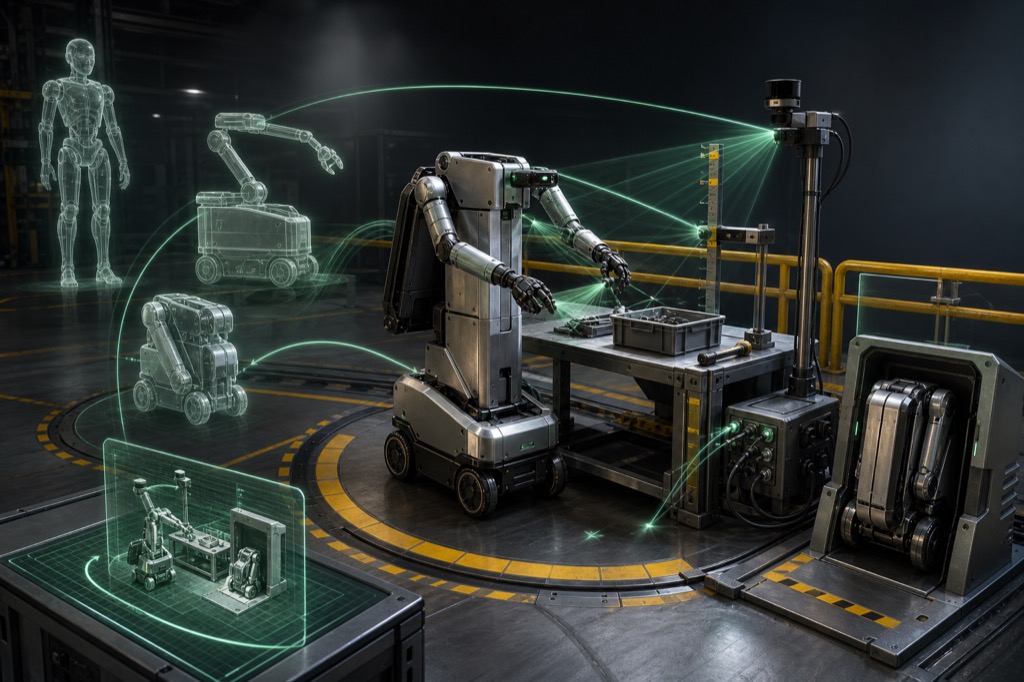
The company unveiled Eno on June 16 as its first general-purpose robot. It has wheels, two arms, proprietary dexterous hands and an articulated body that can adjust height and fold down for storage. It does not have legs. It does not need a face to make the strategic point.
The thesis is simple: physical AI is becoming a form-factor test. The winners will not be the robots that look most human. They will be the systems whose body, model, data loop and safety boundary fit the job better than the alternatives.
The Move
Genesis AI says Eno brings together its full-stack hardware platform with GENE, its robotics-native foundation model. The company frames GENE as the robot's physical agent layer: reasoning through tasks, adapting when conditions change and working beyond fixed scripts.
The design choices are practical. A wheeled base reduces the complexity of walking. Adjustable panels help the robot reach human spaces without copying a full human body. Dexterous hands matter because most tools, shelves, handles and lab objects were designed for human manipulation.
The optional screen is also a useful signal. Genesis AI says Eno can show what it is thinking and doing in real time. In shared workspaces, trust is not just model performance. People need to know what a moving machine is about to do.
The Real Bet
Most robotics debates over-index on shape: humanoid versus non-humanoid, legs versus wheels, face versus no face. That is the wrong first question.
The better question is: what deployment environment is this robot actually built for?
Business Insider reports Genesis AI plans to produce dozens of robots by the end of 2026 and begin small-scale customer deployments with manufacturers, logistics companies and laboratories. Those are not chaotic home environments. They are controlled spaces with clearer routes, repeatable workflows and staff who can define tasks.
In that setting, wheels may be a feature, not a compromise. A robot that rolls reliably through a lab or warehouse, reaches the right height, handles objects well and exposes its intent could beat a bipedal robot that is more impressive in a demo but harder to deploy.
The Data Engine Is The Product
The most important part of Genesis AI's strategy may not be Eno's silhouette. It is the data system around it.
In May, Genesis AI announced GENE-26.5 and described a full-stack approach that includes a dexterous robotic hand, tactile data-collection gloves, simulation and real-world data. The company says its glove hardware is 100 times cheaper than typical options and, in internal testing, up to five times more efficient than traditional teleoperation.
Business Insider also reports Genesis AI plans to deploy thousands of wireless gloves with industrial partners later this year. That matters because robots do not have the internet-scale training corpus that language models had. The bottleneck is high-quality physical demonstration data: how skilled people grip, twist, align, recover and sequence tasks in the real world.
If Genesis AI can collect that data cheaply and map it cleanly into its hand and model stack, Eno becomes more than hardware. It becomes the visible endpoint of a learning system.
The Operator Test
For buyers, the diligence checklist should be blunt.
First, task fit. What job can Eno do repeatedly at a customer site without heroic setup?
Second, intervention rate. How often does a human need to rescue the robot, reset the scene or take over?
Third, environment fit. Are the floors, routes, objects, lighting and safety zones compatible with the robot's body?
Fourth, transparency. Can workers understand what the robot is doing before it moves, reaches or changes plan?
Fifth, learning loop. Does every deployment improve the model through better data, or does each customer become a custom integration project?
That checklist is more useful than asking whether the robot is humanoid. Humanoid design may be right for some environments. It is not automatically right for the first commercial wedge.
The Founder Opening
The startup lesson is to start with the workflow before choosing the body.
Physical AI companies should define the customer environment, task boundary, data source, safety model and maintenance path before they define the robot's personality. The best product may be a wheeled robot, a fixed workcell, a dexterous arm, a mobile cart, a drone, a wearable tool or a humanoid. The job should decide.
That creates openings around the robot as well: data-capture tools, simulation pipelines, safety observability, fleet operations, maintenance software, skill evaluation and deployment analytics.
The robot race will not be won by aesthetics alone. It will be won by the teams that turn embodiment into measurable work.
The Takeaway
Genesis AI's Eno is a useful reminder that physical AI is not just intelligence in a body. It is intelligence constrained by floors, hands, tools, humans, safety rules and economics.
The next general-purpose robot may not look like a person. It may look like the first machine that actually fits the work.
Sources
- https://www.prnewswire.com/news-releases/introducing-eno-genesis-ais-first-general-purpose-robot-is-challenging-traditional-humanoid-design-302801103.html
- https://www.genesis.ai/press/press-release-gene-265
- https://www.businessinsider.com/genesis-ai-unveils-robot-with-no-head-or-legs-2026-6
- https://thenextweb.com/news/genesis-ai-thinks-the-humanoid-hype-is-wrong-its-wheeled-robot-is-the-counterargument