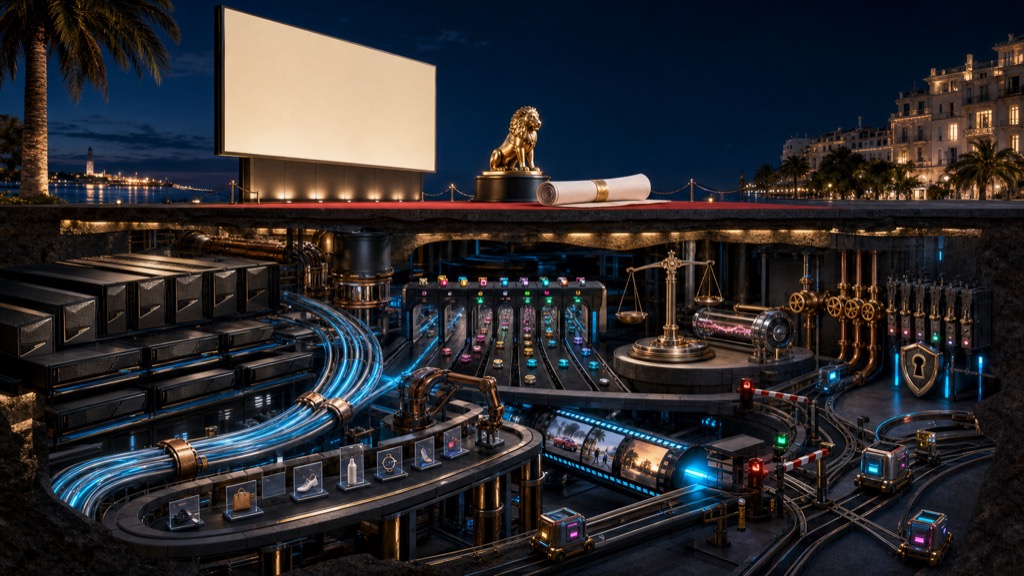
The next stage of AI in advertising is not another image generator bolted onto a campaign brief. It is the boring, expensive layer underneath the brief: inference speed, training cost, auction latency, measurement quality, permissions and agent control.
NVIDIA's Cannes Lions partner push makes that shift visible. The company is not just saying marketers should use AI. It is showing a stack of partners using NVIDIA systems to move AI into the operating layer of advertising: causal measurement, real-time bidding, recommendation training, creative production, contextual video intelligence and campaign agents.
The thesis is simple: advertising AI is becoming infrastructure. The winners will not be the teams with the flashiest demo. They will be the teams that can make AI fast, measurable, governed and cheap enough to run inside live marketing operations.
The Move
NVIDIA's June 18 announcement names Alembic, AWS, Criteo, Higgsfield, KERV.ai and Taboola as Cannes Lions examples.
The concrete claims matter. NVIDIA says Alembic will use DGX Vera Rubin SuperPODs for enterprise-scale causal modeling. AWS is bringing a reference implementation for AI-powered bidding inside ad auctions using NVIDIA Triton Inference Server. Criteo achieved roughly a 2x training speedup on NVIDIA Blackwell GPUs and freed roughly 17,000 GPU hours a year through NVIDIA cuEmbed work.
The creative side is also becoming operational. NVIDIA says Higgsfield Supercomputer agents manage ideation, planning, creative production, posting and campaign optimization in one interface, and that campaigns for nearly 400 Fortune 500 companies are created on the platform. KERV.ai, meanwhile, says it optimized video/content analysis for over 10x speed and efficiency using NVIDIA Nemotron 3 Nano Omni.
This is not one product story. It is a map of where adtech AI is hard.
The Real Signal
Advertising has spent the first generative AI cycle talking about output: copy, images, storyboards, videos and variations. That mattered, but it also made the category easy to overstate.
Adweek's Cannes coverage of Publicis' "AI pitch-maxxing" critique captures the buyer mood: clients want proof of business impact, not a louder pile of AI promises. Cannes Lions' own AI advertising programme frames the shift as advertising moving from a media operating model to an intelligence operating model.
That is the right frame. If AI becomes the interface through which consumers search, ask, compare and act, advertising cannot remain a campaign calendar wrapped around media slots. It becomes a system that senses demand, creates assets, prices attention, adapts placement and proves causality.
That system needs infrastructure.
The Operator Checklist
For marketing and product leaders, the useful question is no longer "Which AI tool makes creative faster?" It is "Which workflow deserves production AI?"
Start with latency. Real-time bidding cannot wait for elegant model behavior. If inference misses the auction window, it is irrelevant.
Then cost. A model that improves targeting but burns margin at scale is not a business system. Criteo's reported GPU-hour savings are important because efficiency compounds across retraining loops and recommendation networks.
Then evidence. Alembic's causal modeling angle points at the hardest budget question in marketing: what actually drove growth? AI that only creates more content increases noise. AI that improves capital allocation changes the operating model.
Then control. Campaign agents that plan, generate, post and optimize need role-based permissions, audit trails, safety limits and rollback paths. Autonomous marketing without governance is just a faster way to create brand risk.
Finally, deployment fit. Some workloads belong in cloud auctions. Some belong near private enterprise data. Some belong in agency workbenches. The infrastructure choice should follow the data, latency and compliance boundary.
The Founder Opening
The opportunity is not to build "AI for marketing" as a broad slogan. The opportunity is to own a narrow control point.
One wedge is auction intelligence: models that score bids, audiences and deals inside strict latency and cost budgets. Another is creative operations: agents that move from brief to asset to channel while preserving approvals and brand constraints. A third is proof infrastructure: causal measurement, incrementality, spend waste detection and executive reporting.
There is also room around content intelligence. Video, product placement, scene understanding and contextual targeting all become more valuable when AI can interpret media at the object, moment and intent level.
The common thread is that the buyer is not paying for magic. The buyer is paying for a production constraint to get better: faster retraining, lower inference cost, clearer measurement, stronger governance or more revenue from existing attention.
The Takeaway
NVIDIA's Cannes message is not that every marketer needs more AI-generated creative. It is that advertising AI is moving into the machinery of the business.
That changes the diligence standard. Ask less about how impressive the demo looks. Ask where the model runs, how fast it responds, what it costs, what evidence it produces, who can approve its actions and how the system fails.
The creative teams will still matter. But the next advertising AI advantage may come from the teams that treat marketing like a production system.
Sources
- https://blogs.nvidia.com/blog/nvidia-ai-marketing-advertising-cannes-lions/
- https://www.adweek.com/agencies/publicis-calls-out-ai-pitch-maxxing-ahead-of-cannes-lions/
- https://www.canneslions.com/festival/programme/advertising-in-the-age-of-ai-e1-73687
- https://www.canneslions.com/partnerships/our-partners