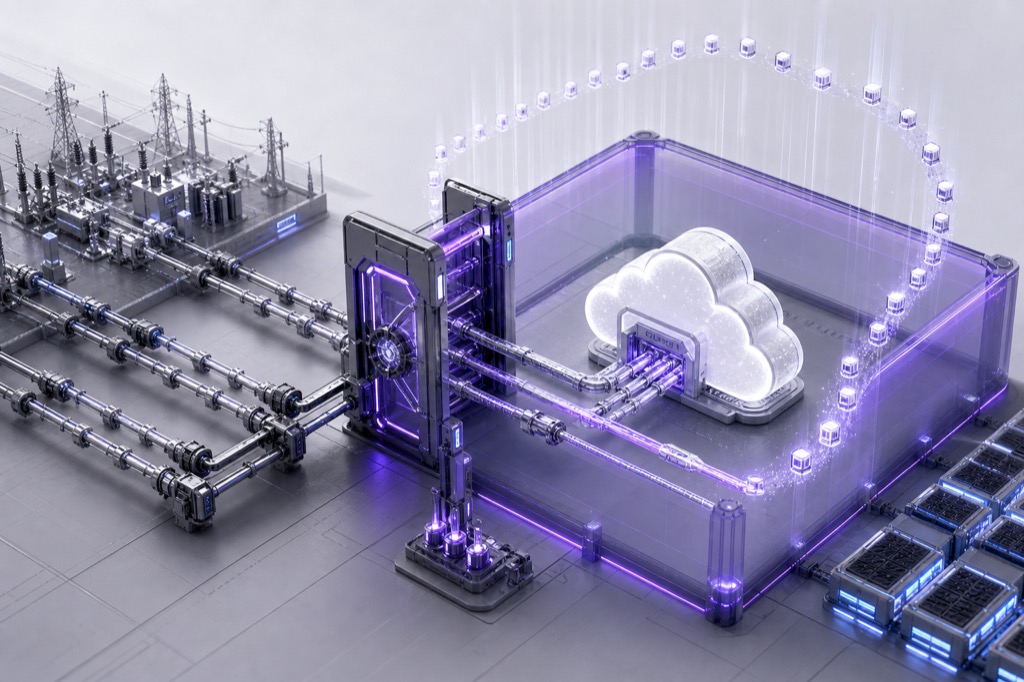
The next AI infrastructure bottleneck is not just GPUs. It is the queue between a data center and usable power.
FERC made that explicit on June 18 when it ordered the six regional grid operators under its jurisdiction to justify or reform how they handle large loads such as data centers and manufacturing facilities. The agency gave operators and transmission owners 60 days to defend current tariffs or propose changes, and 30 days to report how they will ensure enough generation for existing and new large loads.
The thesis: AI cloud is becoming a power-queue business. The winners will not only buy chips. They will turn interconnection strategy, power contracts, tariff risk, co-location, flexible load, and site operations into deployable compute.
The Trigger
FERC's orders cover PJM, MISO, SPP, CAISO, ISO New England, and NYISO. The reform list is unusually operational: faster transmission service applications and studies, transparency into transmission costs, protection against cost shifting, co-location and behind-the-meter generation, flexible large-load services, and study processes for generating facilities that serve nearby data centers.
That is not abstract policy language. It maps directly to the AI data-center operating model.
TechCrunch framed the move as a government-mandated fast lane for AI data centers, but with an important caveat: the order can force process and tariff clarity, yet it does not create spare generation capacity by itself.
That distinction matters. A faster queue is useful. A faster queue into a constrained grid is still a constrained grid.
Why CoreWeave Is A Useful Signal
CoreWeave is a clean example of why power has moved from facilities detail to strategic constraint.
The company says it now operates 49 AI data centers across North America and Europe, with more than 1 GW of active power and more than 3.5 GW of contracted power capacity. Its 2025 Form 10-K showed how quickly that footprint scaled: 10 data centers and about 70 MW of active power at the end of 2023, 32 data centers and about 360 MW at the end of 2024, then 43 data centers and more than 850 MW at the end of 2025.
CoreWeave also told investors it had roughly 3.1 GW of contracted power capacity at the end of 2025 and expects to deploy that capacity over future periods. That is the real operating problem: contracted power is not the same thing as live clusters.
Between those two states sit interconnection studies, transmission upgrades, tariffs, local politics, generation adequacy, cooling, procurement, construction timing, and customer commitments.
The New AI Infrastructure Stack
The old mental model was simple: more chips plus more capital equals more AI capacity.
The new model has four layers.
First is power access. AI cloud operators need sites where large power blocks can actually become usable capacity.
Second is interconnection timing. Berkeley Lab's queue data shows more than 2,060 GW of generation and storage capacity actively seeking U.S. grid connection at the end of 2025. It also reports that only 13% of capacity requesting interconnection from 2000 through 2019 had reached commercial operation by the end of 2024. The line is long, and completion is not guaranteed.
Third is cost allocation. FERC is explicitly pushing grid operators to address cost transparency and prevent cost shifting. That will matter for data-center buyers, utilities, states, and local ratepayers.
Fourth is operational flexibility. FERC's attention to flexible large-load services and behind-the-meter generation points to a future where data centers are not just passive electricity consumers. They may need to prove when they can shift, curtail, self-supply, or coordinate with grid conditions.
What Operators Should Do
Treat power as a product dependency, not a real-estate input.
For AI infrastructure teams, that means every capacity plan should include a power-risk register: grid operator, queue status, tariff exposure, upgrade responsibility, generation assumptions, water and cooling constraints, local approval risk, and fallback capacity.
For enterprise buyers, the diligence question changes. Do not only ask which GPUs are available. Ask where the capacity sits, what power is active versus contracted, what happens if a site slips, and whether workloads can move across regions without breaking latency, compliance, or cost assumptions.
For founders, the opportunity is not another generic data-center dashboard. The wedge is power-aware AI infrastructure software: queue intelligence, site scoring, tariff modeling, flexible-load orchestration, capacity insurance, behind-the-meter planning, and procurement tools that connect power status to customer delivery dates.
The Takeaway
FERC's action is not a magic wand for AI capacity. It is a market signal.
AI infrastructure has entered the phase where power access, grid rules, and operating flexibility sit beside GPUs, networking, and model demand. In that phase, the best AI cloud operators will look less like pure compute resellers and more like systems companies that can convert electricity constraints into reliable product capacity.
The AI stack now has a power queue.
Sources
- https://www.ferc.gov/news-events/news/ferc-launches-aggressive-targeted-action-speed-large-load-integration
- https://www.ferc.gov/news-events/news/fact-sheet-ferc-takes-action-supercharge-americas-grid-efficiency-reliability-and
- https://techcrunch.com/2026/06/18/ai-data-centers-just-got-a-government-mandated-fast-lane-to-the-grid/
- https://www.coreweave.com/ai-data-centers
- https://www.sec.gov/Archives/edgar/data/1769628/000176962826000104/crwv-20251231.htm
- https://emp.lbl.gov/queues