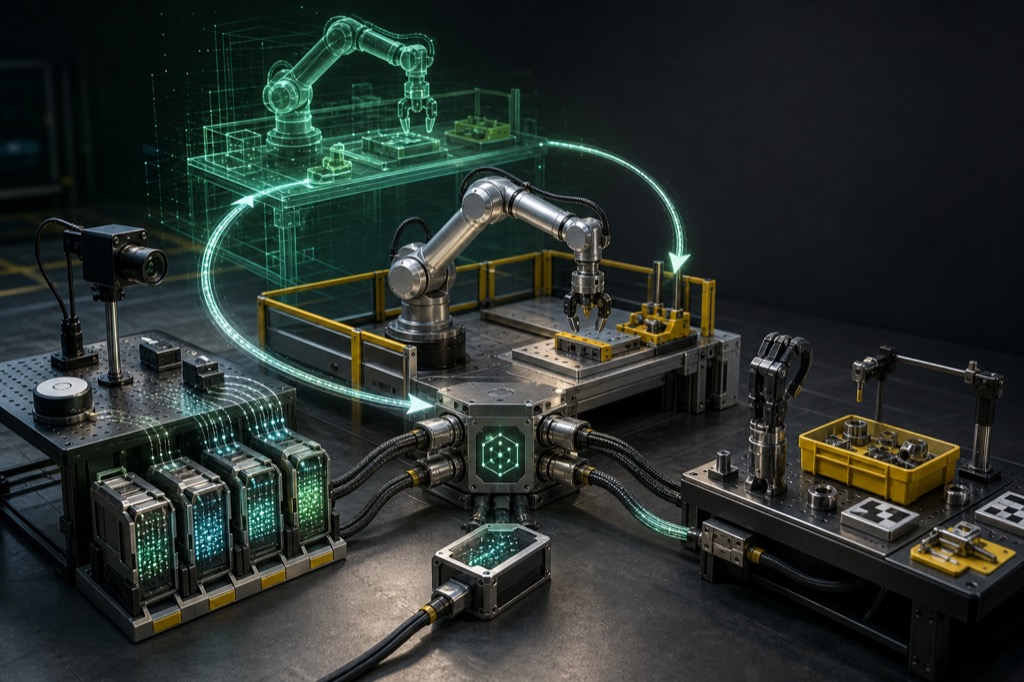
The important signal in NVIDIA's latest Hugging Face move is not another claim that humanoids are almost here. It is the quieter infrastructure shift underneath: robotics AI is starting to look like a shared development loop.
NVIDIA says Isaac Teleop and Isaac GR00T 1.7 are being brought into Hugging Face LeRobot, the open-source robotics library for training, running, and sharing robot datasets, models, policies, and workflows. Cosmos 3 is planned for LeRobot next. Hugging Face's NVIDIA post says GR00T 1.7 is now available in LeRobot, replacing N1.5 in that workflow, and shows a path from demonstration capture to post-training to deployment on an SO-101 robot.
The thesis: robotics AI is becoming less about one magic robot brain and more about the integration layer around data, simulation, evaluation, and deployment.
Why This Matters Now
Robotics has not been held back only by model quality. It has been held back by fragmentation.
Different labs use different robots, datasets, simulators, controllers, evaluation setups, and deployment paths. That makes progress hard to compare and hard to reuse. A model demo may look impressive, but the operator still has to ask: what data format does it need, how is the robot controlled, where is it tested, what benchmark says it improved, and how does it move from simulation to hardware?
The NVIDIA-Hugging Face move points at that bottleneck directly. NVIDIA says the LeRobot integrations give developers a common way to collect and standardize data, fine-tune robot foundation models, evaluate performance, and deploy through open workflows. The included pieces are specific: Isaac Teleop for collecting demonstrations, GR00T 1.7 for open VLA robot policy work, Isaac simulation and Isaac Lab-Arena for testing, and Cosmos 3 planned for world-model-driven data generation and augmentation.
That is not just a tooling announcement. It is a bet that the robotics stack needs a common operating path.
The Evidence Is In The Workflow
The strongest proof is not the headline. It is the workflow detail.
Hugging Face's NVIDIA post walks through data collection for a pick-and-place task, including an example that records 50 episodes and pushes the dataset to Hugging Face Hub. It then shows post-training with `nvidia/GR00T-N1.7-3B`, deployment through `lerobot-rollout`, and vendor-reported LIBERO benchmark averages of 96.5% for LeRobot GR00T 1.7 versus 87% for GR00T 1.5.
Treat those benchmark numbers carefully because they are vendor-reported. The useful point is still clear: the company is packaging robotics model improvement inside a repeatable loop that other developers can inspect, adapt, and compare.
The broader context supports the shift. IEEE Spectrum reported in May that LeRobot hosted more than 58,000 robotics datasets, up from 1,145 at the end of 2024. NVIDIA's July post also says its cited open-source physical AI dataset includes more than 350,000 real and simulated trajectories, 57 million grasps, and more than 15 million downloads.
Robotics is still hard. But the data layer is getting thicker.
The Operator Framework
Teams evaluating robotics AI should stop asking only whether a model looks intelligent. Ask whether the development loop is complete.
First, inspect the data path. Can the team capture demonstrations in a standard format, label them, version them, share them, and reuse them across policies?
Second, inspect the simulation path. Can the team test behaviors before touching hardware, and can it measure what changed when a model, task, or environment changes?
Third, inspect the model path. Can the team fine-tune, compare, roll back, and deploy policies without rebuilding the stack every time?
Fourth, inspect the hardware path. Can the policy actually run on the target robot with the right sensors, latency, controls, and safety constraints?
That is the practical meaning of the LeRobot integration. It makes robotics look more like software infrastructure: pipelines, artifacts, formats, evaluation, deployment, and observability.
The Founder Opening
This creates a more grounded startup map.
The obvious opportunities are not another generic robotics chatbot. They are the missing tools around the loop: dataset quality checks, teleoperation capture workflows, robot-data labeling, sim-to-real test harnesses, policy regression suites, hardware compatibility layers, safety review, deployment monitoring, and fleet learning systems.
Open-source infrastructure does not remove the commercial opportunity. It moves the commercial opportunity up the stack, toward reliability, workflow fit, compliance, support, and operational proof.
The Takeaway
Robotics AI is entering the same phase software AI entered earlier: the model matters, but the surrounding system decides whether anyone can use it repeatedly.
NVIDIA and Hugging Face are not proving that robots are solved. They are showing where the next serious work sits.
The winning robotics teams will not only have a better policy. They will have a better loop: collect data, standardize it, train against it, test it, deploy it, measure it, and improve it without starting over.
That is the shift worth watching.