The model race is starting to look too narrow.
NVIDIA and LangChain's new NemoClaw for LangChain Deep Agents blueprint is interesting because it does not frame agent performance as a model-only problem. The stack combines NVIDIA Nemotron 3 Ultra, LangChain Deep Agents Code, and NVIDIA OpenShell. LangChain says its evals put Nemotron 3 Ultra with the tuned Deep Agents harness at a 0.86 aggregate score for $4.48, while the next closest performing model cost $43.48 on the same benchmark.
The thesis: enterprise agents will be judged less by raw model access and more by how well the surrounding harness turns model calls into governed, repeatable, cost-controlled work.
Why This Matters Now
Agents are expensive in a different way than chatbots.
A chatbot may answer once. An agent plans, reads, calls tools, retries, writes intermediate state, checks results, and may run for minutes. Every bad planning step or sloppy tool call becomes cost, latency, and operational risk.
That is why harness engineering matters. NVIDIA says LangChain tuned the environment around Nemotron 3 Ultra, not the model weights. LangChain says the work focused on how the agent uses tools, manages context, and evaluates intermediate steps. Crusoe's technical write-up describes the same pattern around a 127-example Deep Agents evaluation suite, citing 86.6% accuracy for Nemotron 3 Ultra and roughly $4 to $5 in token cost versus about $43 for Claude Opus 4.7, based on public pricing.
Those numbers should not be treated as universal production proof. They are benchmark claims. But they point to the right operating question: can the system around the model remove wasted agent work?
The New Agent Stack
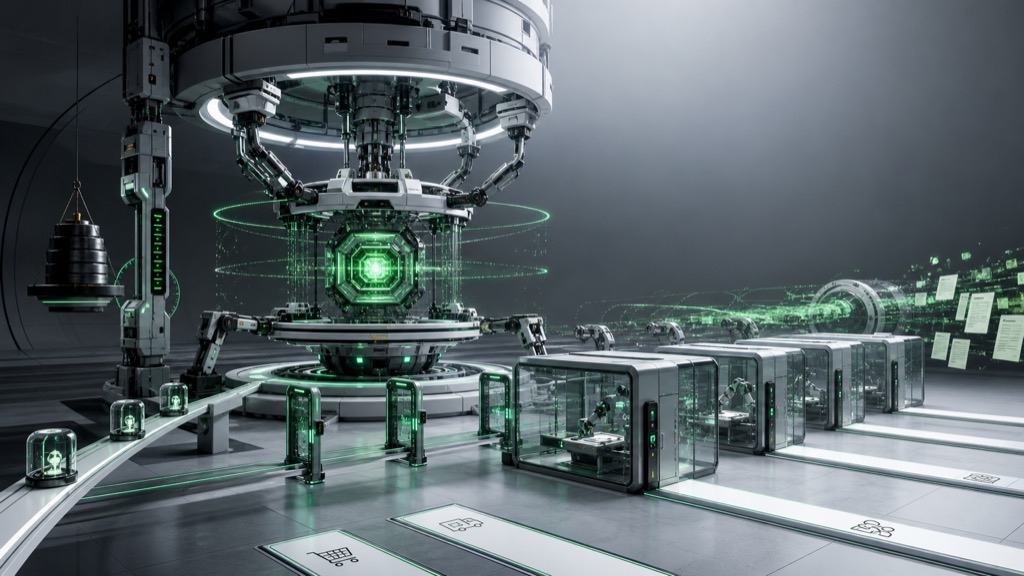
The useful way to read this launch is as a four-layer stack.
First is the model. NVIDIA's developer page lists Nemotron 3 Ultra 550B A55B as the Ultra model for complex multi-agent enterprise workflows, with the broader Nemotron 3 family described as supporting 1M-token context.
Second is the harness. LangChain Deep Agents handles planning, tool use, memory, and task execution. The tuned profile makes the harness model-aware instead of treating every model like an interchangeable API endpoint.
Third is the runtime. NVIDIA OpenShell is positioned as the governed execution layer, where agents interact with tools, systems, and data under policy controls.
Fourth is deployment. NVIDIA lists hosted and self-managed routes including NIM microservices, vLLM, SGLang, Ollama, llama.cpp, Baseten, Crusoe, Nebius, Together AI, and others. That matters because agent economics are not just prompt design. They are also inference placement, latency, throughput, and operational ownership.
The Operator Lesson
Most teams evaluating agents still ask the wrong first question: which model is smartest?
The better question is: which workflow can be measured and improved?
For production agents, operators should evaluate five artifacts:
- The task suite: representative jobs, not demo prompts.
- The trace: where the agent reads, calls tools, retries, and fails.
- The harness profile: prompts, tool descriptions, middleware, memory, and subagents.
- The runtime policy: what the agent can touch, where it executes, and how evidence is logged.
- The cost per successful task: not cost per token in isolation.
This is where the NVIDIA/LangChain move is strategically useful. It shifts the conversation from model leaderboard theater to system-level agent work. If a team can tune the harness, replay traces, control runtime behavior, and compare cost per completed task, it has an operating loop. Without that loop, it has a vendor demo.
The Founder Opening
This launch also exposes a product opportunity.
Enterprises will need agent evaluation infrastructure that sits above model providers. The valuable product is not another wrapper. It is a control plane that records traces, identifies wasteful steps, proposes harness changes, runs regression tests, enforces runtime policy, and reports cost per successful workflow.
That product can serve both sides of the market. Buyers get a way to compare open and closed agent stacks without trusting generic benchmarks. Model and infrastructure providers get a way to prove where they are genuinely cheaper or more reliable.
The highest-value wedge is narrow: pick one workflow, define success, measure every agent step, and optimize the harness until the cost curve changes.
The Takeaway
NVIDIA and LangChain are not proving that every enterprise should switch to an open agent stack tomorrow. Benchmarks are only a starting point, and regulated teams still need their own security, compliance, latency, and reliability testing.
But the direction is clear. Agent performance is becoming a systems problem. Models still matter, but the durable advantage may come from the harness, eval loop, runtime, and deployment path around them.
The next serious agent question is not "which model did you use?"
It is "what did the harness learn?"