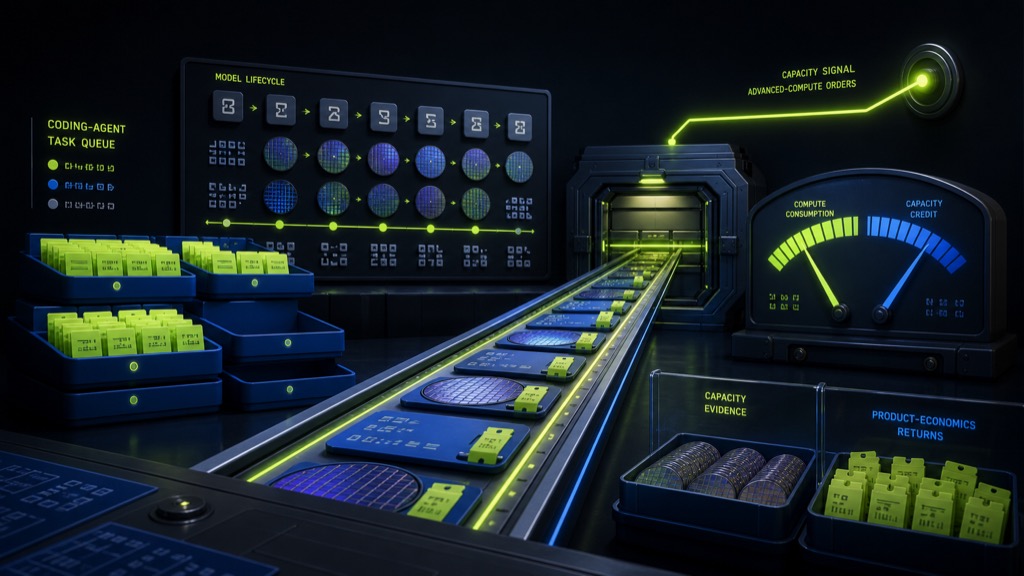
AI demand is becoming visible in a place where enthusiasm has to turn into purchase orders: the foundry.
TSMC reported June revenue of NT$442.68 billion, up 67.9% from a year earlier. Its first-half revenue reached NT$2.404 trillion, up 35.6%. Reuters calculated second-quarter revenue at about NT$1.27 trillion, a record and slightly above the LSEG consensus it cited.
The signal is real. The interpretation needs discipline.
TSMC's sales show that customers are consuming semiconductor capacity at scale. They do not prove that every AI product, model provider, or data-center buyer has durable economics. Operators should read the numbers through three layers: capacity, mix, and returns.
1. Capacity: AI Spending Has Reached the Factory
Foundry revenue is more concrete than a product roadmap or executive survey. It reflects chips moving through an expensive manufacturing system.
TSMC's first-quarter report adds useful context. High-performance computing represented 61% of net revenue, up from 55% in the previous quarter. Processes at 7 nanometers and below generated 74% of wafer revenue. The company also spent US$11.10 billion on capital equipment in the quarter.
Those figures do not isolate AI accelerators—TSMC's high-performance-computing category is broader than AI—but together they show where the manufacturing mix is concentrating: advanced, compute-heavy products.
For infrastructure teams, the lesson is straightforward. Capacity planning cannot rely only on model benchmarks. It must track the industrial constraints behind them: leading-edge wafers, packaging, memory, networking, power, and deployment lead times.
2. Mix: The Bottleneck Is Becoming the Product
When demand reaches a constrained supplier, access becomes a competitive feature.
AI companies often describe their differentiation at the model or application layer. But the ability to reserve capacity, qualify alternate components, forecast workloads, and redesign around supply constraints can determine whether a product ships reliably and at a viable cost.
This creates an opening for founders building the coordination layer around compute: workload forecasting, inference scheduling, hardware-aware model optimization, capacity marketplaces, packaging inspection, power management, and supplier-risk software. The opportunity is not another generic AI wrapper. It is reducing the cost and uncertainty of turning compute demand into delivered service.
3. Returns: Upstream Strength Is Not Downstream Proof
TSMC's monthly release does not disclose which customers drove June growth, how much came from AI, or whether buyers are earning attractive returns on the resulting systems. It also does not provide full second-quarter margin or outlook detail; TSMC's earnings update was scheduled for July 16.
That distinction matters. A supplier can benefit while customers compete away margins, overbuild capacity, or struggle to monetize usage. Record foundry sales answer, "Is infrastructure being ordered?" They do not answer, "Is each AI workload economically sound?"
Operators should pair supply-chain signals with four internal measures:
- utilization by workload, not aggregate reserved capacity;
- cost per successful task, not cost per token alone;
- gross margin after inference, orchestration, and human review;
- revenue retention for customers using AI features versus those merely testing them.
The Takeaway
TSMC's quarter moves the AI infrastructure story from intention to industrial throughput. That is a meaningful demand signal.
The winning operators will not mistake it for a universal business-model verdict. They will connect capacity evidence to product usage and unit economics—then build where the physical bottlenecks remain expensive, slow, and poorly coordinated.