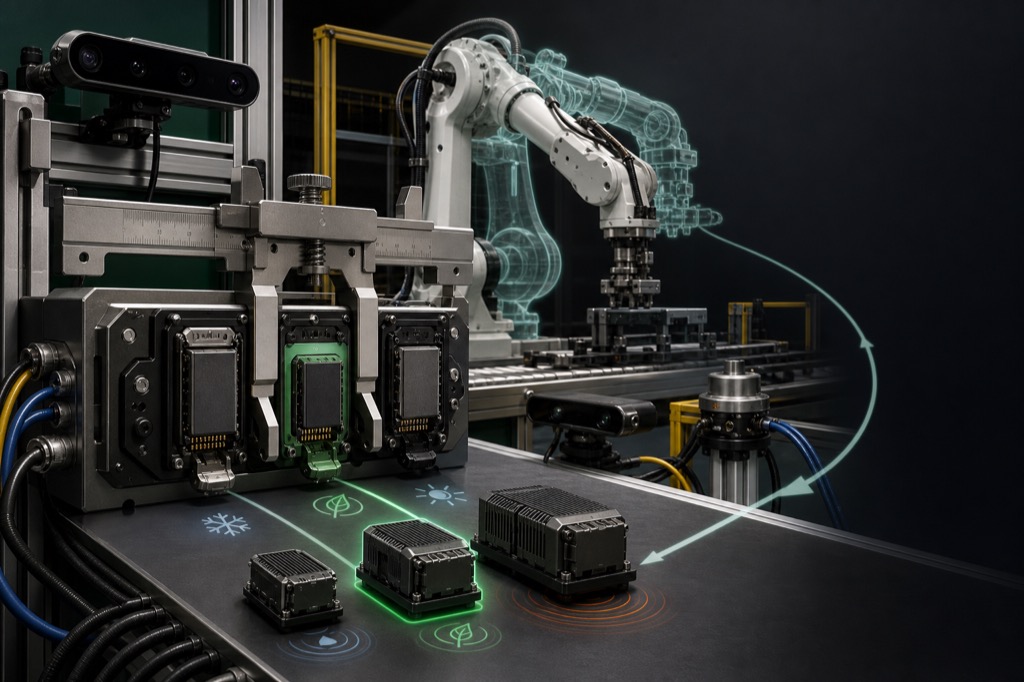
The most important number in NVIDIA's new robotics announcement is not 865 teraflops. It is 32GB.
NVIDIA introduced two smaller Jetson Thor modules on July 15: T3000 with 865 sparse FP4 teraflops and 32GB of memory, and T2000 with 400 sparse FP4 teraflops and 16GB. The company is no longer selling only the biggest possible “robot brain.” It is building a ladder of compute, memory, power, and size options around one physical-AI stack.
That changes the operator question. The goal is not to buy the fastest module. It is to prove which module fits the robot's workload and operating envelope with enough evidence to survive production.
The Shift Is From Peak Compute to Deployable Fit
T3000 combines an eight-core Arm CPU, 32GB of LPDDR5X memory, 273GB/s of bandwidth, and 25GbE connectivity. NVIDIA says it is roughly half the size and power of T5000 while delivering similar inference performance for multimodal workloads.
That performance statement is not yet independently proven. T3000 and T2000 are scheduled for Q1 2027, with T3000 emulation due later this month in JetPack 7.2.1 and T2000 emulation promised for a later release.
The schedule matters because emulation can screen designs, but it cannot settle thermals, battery life, sensor timing, or production reliability.
Use the Workload–Envelope–Evidence Test
1. Workload
Start with the actual execution graph, not a TOPS or teraflops comparison.
Inventory every model, precision, sensor stream, control loop, and concurrent process. Measure peak memory, time to first action, steady-state latency, and recovery after overload. A vision-language-action model sharing memory with perception, mapping, and safety services is a different workload from a single benchmark model.
NVIDIA's 4-billion-parameter Cosmos 3 Edge model illustrates the direction: more reasoning is moving onto the device. That makes memory contention and scheduling as important as nominal accelerator throughput.
2. Envelope
Translate the workload into the robot's physical limits: sustained watts, heat rejection, battery duration, module volume, camera links, networking, and bill of materials.
Independent testing of the existing T5000 shows why this step cannot be skipped. ServeTheHome documented its 40W-to-130W range and warned that operation above 100W is material for battery-powered robots. More compute is useful only if the machine can power and cool it through the full duty cycle.
T3000's smaller footprint could widen deployment, but “half the size and power” remains a vendor claim until production hardware is tested inside representative machines.
3. Evidence
Use T3000 emulation as an early rejection tool, not a design-lock certificate.
Define acceptance gates before testing:
- task success under peak sensor and model concurrency;
- p95 and worst-case action latency;
- memory headroom after hours of operation;
- sustained power, temperature, and battery impact;
- safe degradation when a model or sensor stalls;
- performance after software updates.
There is reason to test NVIDIA's claims seriously. ServeTheHome measured the T5000 at 149.1 tokens per second on Llama 3.1 8B versus NVIDIA's 150.8 reference, although the reviewer noted limited test time. That validates one platform baseline, not the new modules or every robotics workload.
Software Optimization Is Now a Hardware Lever
NVIDIA is also positioning agent-assisted memory optimization as a way to move products onto smaller modules. The company reports that named Jetson customers reduced memory use by as much as 15GB, while another reported a 30% reduction. Those are vendor-reported examples, not audited outcomes, but the strategy is sound: software efficiency can change the bill of materials.
Founders should treat memory optimization, workload schedulers, thermal-aware inference, and migration testing as product opportunities. Operators should make those tools earn their value through repeatable measurements, not demo-day savings.
The Takeaway
T3000 and T2000 make NVIDIA's physical-AI stack more deployable by creating more places to land. They also make procurement harder: teams now need to choose the smallest module that meets the real workload with defensible headroom.
The winning robot will not have the largest compute number. It will have the best-evidenced fit between intelligence, power, heat, memory, and cost.