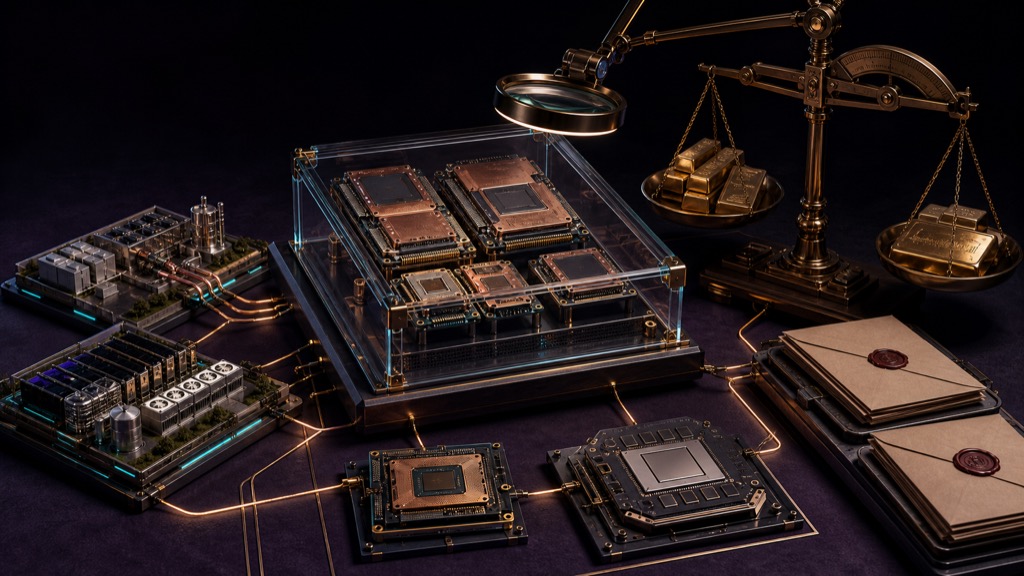
General Compute did not just raise money for compute. It reportedly persuaded a lender to treat inference-specific chips as collateral for a $400 million loan.
That makes this more than another AI infrastructure funding story. The next phase of the compute market will be shaped not only by which chip produces tokens fastest, but by which full stack lenders can underwrite: silicon, sites, software, and signed demand.
What The Deal Actually Signals
TechCrunch reports that Upper90 provided the private inference-cloud startup with a $400 million chip-backed loan. The publication says the deal may be the first to use inference-specific accelerators, rather than mainstream GPUs, as collateral. General Compute had raised a $15 million seed round in May.
The planned stack is unusually specific. General Compute's own whitepaper says it currently runs agent workloads on SambaNova SN40L systems. In Q4 2026, it plans to send the parallel prefill phase to AMD MI300X GPUs and the sequential decode phase to SambaNova's SN50, all behind one API. The company also says it has an executed SambaNova capacity agreement and options on 15 megawatts of air-cooled power.
SambaNova says SN50 offers five times more compute and four times more network bandwidth than its prior generation. General Compute publishes large latency advantages against a selected GPU-cloud comparison. Those are company-reported benchmarks, not proof of future utilization or loan performance.
The financing is the stronger signal: a lender was willing to organize substantial capital around the assets and the operating plan.
The Financeability Stack
Specialized chips become infrastructure only when four layers survive diligence.
1. Silicon: Can Performance Outrun Depreciation?
Tokens per second are not enough. A lender needs evidence about failure rates, useful life, upgrade cadence, replacement cost, and residual value. A fast chip with one buyer and no secondary market can still be weak collateral.
Operators should benchmark the exact models, prompt lengths, batch sizes, and latency targets they expect to sell. Vendor peak numbers belong in the appendix, not the base case.
2. Sites: Can Capacity Arrive Before Demand Moves?
General Compute's air-cooling claim matters because power and cooling determine when financed hardware can earn revenue. Existing colocation space can shorten deployment relative to a new liquid-cooled build, but the diligence packet still needs rack density, power price, interconnect, installation lead time, and outage assumptions.
Idle chips are not infrastructure. They are inventory with a power bill.
3. Software: Can Workloads Move?
Specialized silicon carries platform risk. Model coverage, API compatibility, observability, routing, and migration paths determine whether customers can adopt it without rebuilding their applications.
General Compute's proposed split—AMD for prefill, SambaNova for decode—turns orchestration into part of the asset. If the routing and cache handoff work, heterogeneous hardware becomes one service. If they do not, the lender owns disconnected components.
4. Sales: Is Utilization Contracted Or Hoped For?
The final layer is demand. Signed capacity agreements, committed workloads, customer concentration, renewal terms, and measured utilization matter more than a broad forecast for AI tokens.
This is where operators should connect each rack to a revenue case. The strongest financing dossier shows not just what the system can run, but who is expected to run it, when, and under what commitment.
What Founders Should Build Around This Shift
As AI hardware fragments, lenders will need a neutral control layer: workload benchmarks, asset registries, utilization telemetry, power-and-cooling evidence, contract-to-capacity matching, and residual-value models across chip families.
That is a founder opportunity hiding inside the loan. GPU finance matured after markets learned how to value the hardware and its cash flows. Specialized inference finance will need the same translation layer, but for a more heterogeneous fleet.
The Operator Takeaway
The reported loan does not prove that SN50 economics will beat GPUs, that General Compute will fill its capacity, or that inference chips have a liquid resale market. Its terms have not been disclosed.
It proves something narrower and still important: capital is beginning to evaluate specialized inference as financeable infrastructure. The winners will not simply post the fastest benchmark. They will make the entire financeability stack legible enough for customers, operators, and lenders to trust.