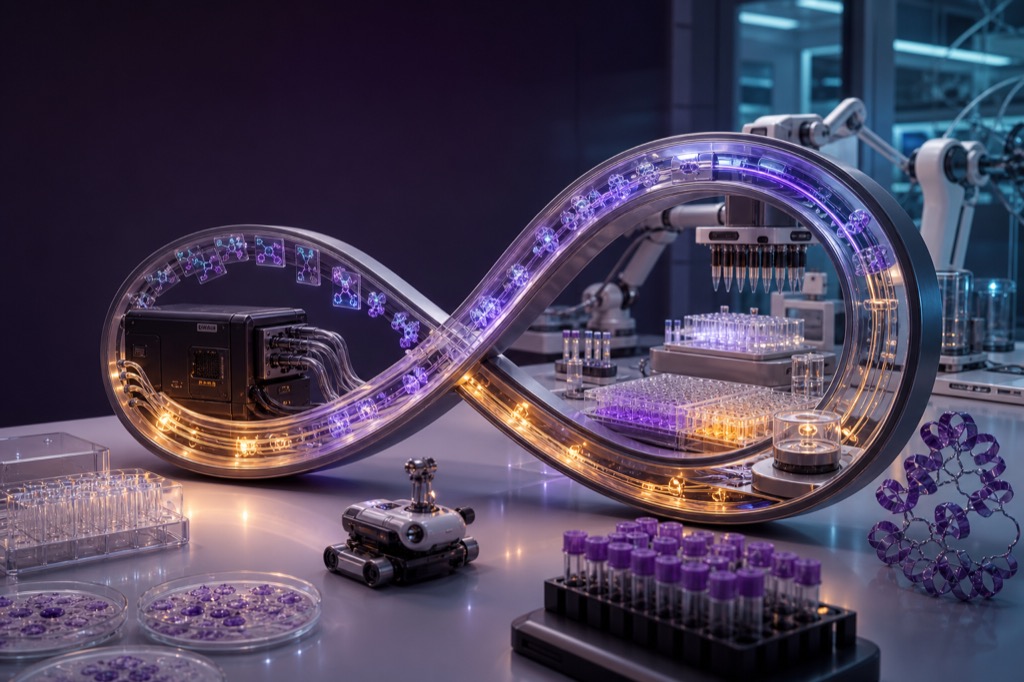
Bristol Myers Squibb is buying a second NVIDIA AI supercomputer. The important part is not that the machine is bigger. It is that BMS wants to connect prediction, laboratory work, and measured outcomes into a faster research loop.
That is the real infrastructure bet: compute creates leverage only when the workflow around it learns.
What BMS Is Building
BMS announced a DGX SuperPOD built on eight NVIDIA Vera Rubin NVL72 systems. The company says the new cluster can deliver up to ten times more performance per megawatt than the infrastructure it replaces. It will support proprietary biological foundation models, NVIDIA BioNeMo tools, and agentic workflows across drug discovery.
The operating scope is already concrete. BMS says AI agents for target identification and validation save scientists weeks of manual work. Its “Predict First” method uses model outputs to guide experiments before work begins at the bench, informing every small-molecule program and most large-molecule programs.
Reuters adds two useful details from BMS executives. The company expects to evaluate dozens of early candidates in some cases where it might previously have evaluated ten. Its research chief also estimates that AI has reduced the time needed to make medicines for trial testing by 20% to 30%.
Those are company claims, not independent proof of better clinical outcomes. Financial terms were not disclosed. But the deployment is specific enough to reveal what enterprise AI looks like when it moves beyond a chatbot layer.
The Scientific Flywheel
The machine matters only if four parts turn together.
1. Access
NVIDIA says BMS plans to make the system available broadly to scientists instead of limiting it to a small specialist group. That can remove a compute queue, but access also needs identity, permissions, data lineage, cost controls, and reproducible environments. Otherwise scarcity becomes sprawl.
2. Prediction
More compute lets teams score more targets, molecules, and biological hypotheses. The useful metric is not predictions generated. It is how well the system ranks the next decision.
Operators should track prospective accuracy: which recommendations were made before an experiment, which were selected, and how often they improved the decision relative to the existing process.
3. Experiment
Wet-lab capacity remains scarce. Faster inference can create a bigger queue of plausible candidates without increasing the number of experiments that scientists can run.
The workflow therefore needs an explicit handoff: model confidence, novelty, expected information gain, safety constraints, and the cost of being wrong should determine what reaches the bench. BMS's Predict First approach points in this direction.
4. Learning
Every experiment—including a negative result—must return to the system with its context intact. Which model proposed it? Which data and version were used? What protocol ran? What contradicted the prediction?
Without that lineage, the cluster produces outputs. With it, the organization builds a compounding evidence asset.
What Operators Should Measure
A life-sciences AI factory needs a scorecard that joins technical and scientific operations:
- time from research question to ranked candidates;
- percentage of predictions evaluated prospectively;
- experiment yield and information gained per lab slot;
- reproducibility across model, data, and protocol versions;
- utilization, energy, and cost per decision—not just per token;
- time required to return experimental outcomes to the next model cycle.
These measures expose the common failure mode: a faster model attached to the same slow, poorly instrumented handoffs.
The Opportunity Around the Machine
The founder opportunity is not another generic drug-discovery model. It is the control layer between models and laboratories: experiment orchestration, scientific-agent observability, evidence lineage, permissioning, negative-result capture, evaluation, and energy-aware scheduling.
Infrastructure suppliers should expect buyers to demand proof at this layer. Performance per megawatt matters, especially as workloads expand. But procurement will increasingly ask a harder question: how many better, auditable research decisions did the system enable?
The Takeaway
BMS has not proved that eight Vera Rubin systems will produce more successful medicines. It has shown the architecture of the bet.
The durable advantage will not come from owning the largest machine for a moment. It will come from closing the loop between prediction, experiment, and learning faster—and with better evidence—than the rest of the industry.