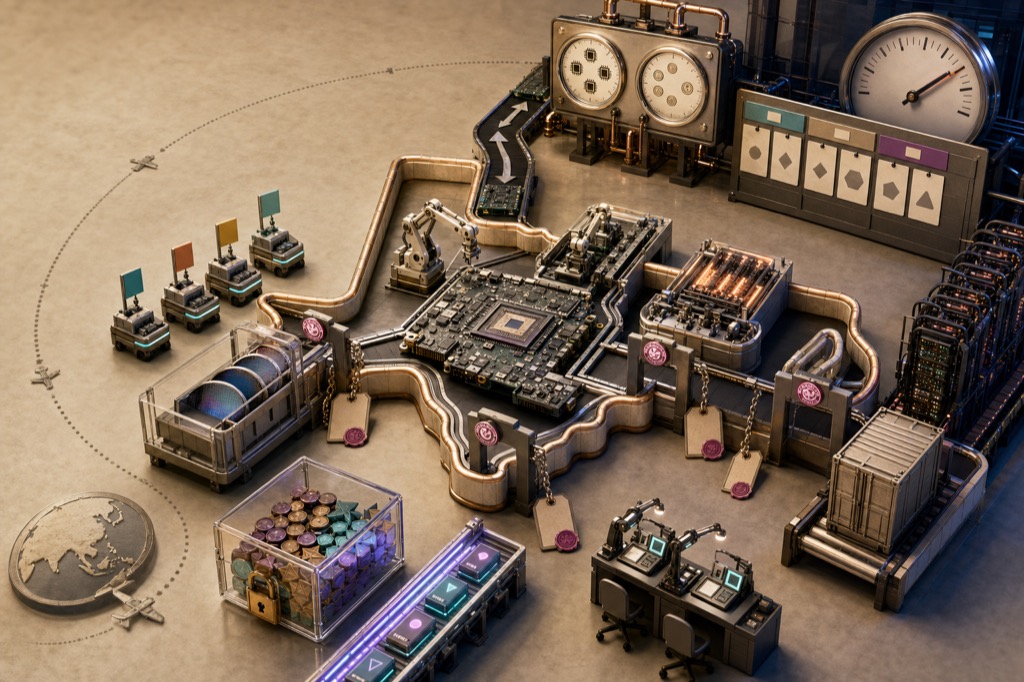
An AI system assembled in Texas can still contain a 7,000-mile manufacturing loop.
That does not make Wistron's new Fort Worth factory cosmetic. It makes the real unit of AI supply-chain resilience easier to see: not a country label, but a qualified handoff.
The thesis: Wistron's U.S. production capacity matters because it brings board assembly, system integration, testing, and factory know-how closer to customers—but operators still need proof at every boundary from wafer to rack.
What Opened in Fort Worth
NVIDIA says Wistron's 324,000-square-foot D1 facility opened July 21 as Wistron's first U.S. factory. One manufacturing cell is producing GB300 Grace Blackwell Ultra boards; another is intended for Vera Rubin. The stated target is tens of thousands of boards per month.
The factory is also an AI deployment, not just a factory for AI. Wistron says it simulated the facility before construction using a digital twin built with NVIDIA models and Omniverse-related tools. Engineers used it to validate line layouts, optimize production processes, and train workers before equipment came online.
NVIDIA attributes a $700 million commitment and more than 500 current jobs to the Texas operation, with a plan to reach 1,000 by year-end. Wistron's board had separately approved up to $49.9 million in additional capital expenditure for its Texas Eagle plant. These figures show commitment; the future production and employment targets still need to be measured against actual output.
The Missing Middle
“Made in America” is too blunt for an AI rack.
Tom's Hardware reports that Blackwell dies fabricated in Arizona still travel to Taiwan for advanced packaging. High-bandwidth memory also remains an offshore dependency. Wistron's U.S. role covers later stages: boards, trays, racks, system assembly, and test.
That distinction is not a gotcha. Local integration can shorten delivery, repair, and qualification loops while building valuable process knowledge. But it does mean procurement teams should stop treating origin as a single field.
The Four-Handoff Map
Every critical component should carry four answers.
1. Origin
Where were the wafer, package, memory, substrate, board, and final system actually produced? “U.S.-built” should never erase upstream geography.
2. Transformation
What value was added at each stage—fabrication, packaging, board assembly, liquid-cooling integration, rack test, firmware, or burn-in? This reveals which capability is local and which is merely passing through.
3. Qualification
What evidence proves the component and process meet requirements? Track serialized parts, test results, firmware versions, line configuration, defect history, and approved substitutions.
4. Recovery
If one handoff fails, how quickly can the system switch supplier, line, package, memory stack, or product generation? A resilient chain is not one with no dependency. It is one with rehearsed alternatives and measurable recovery time.
The Operator Playbook
Start with the physical bill of materials, then add a provenance graph. Connect every serialized component to its source facility, transformation step, test evidence, and approved replacement.
Next, test the generation transition. D1's GB300 and planned Vera Rubin cells make changeover capability a strategic metric. Measure time to qualify a new board, retrain workers, update the digital twin, stabilize yield, and close field failures.
Finally, separate marketing claims from operating metrics. Useful measures include first-pass yield, rework rate, supplier concentration, cross-border transit time, mean time to qualify a substitute, trace completeness, and recovery time after a constrained component.
The Founder Opportunity
The opening is a product signal for supply-chain software. Manufacturers and buyers need a shared evidence layer that connects component provenance, factory configuration, test results, digital-twin revisions, and substitution approvals without forcing every participant onto one planning system.
The valuable product is not another dashboard. It is a verifiable chain of custody for capability: what was built, where value was added, what passed, and what can replace it.
The Takeaway
Wistron's Fort Worth plant adds real U.S. AI-system capacity. It also exposes the limits of binary sourcing language.
AI infrastructure becomes resilient when every handoff is visible, qualified, and recoverable—from packaged silicon to the finished rack.
Sources
- NVIDIA Blog, “Built in Fort Worth: Wistron Opens Advanced Manufacturing Plant to Produce NVIDIA AI Systems” (2026-07-21): https://blogs.nvidia.com/blog/wistron-manufacturing-texas/
- Wistron, “Wistron announcement” (2026-01-22): https://www.wistron.com/en/Newsroom/2026-01-22
- Tom's Hardware, “Nvidia and Intel tout homegrown American chip supply chain prowess as country bolsters local production, but gaps remain” (2026-07-06): https://www.tomshardware.com/tech-industry/nvidia-and-intel-tout-chips-built-in-america-but-every-arizona-made-blackwell-die-is-still-packaged-in-taiwan
- Community Impact, “Wistron InfoComm Corporation to invest $687M for 2 locations in Fort Worth” (2025-07-22): https://communityimpact.com/keller-roanoke-northeast-fort-worth/development/wistron-infocomm-corporation-to-invest-687m-for-2-locations-in-fort-worth/