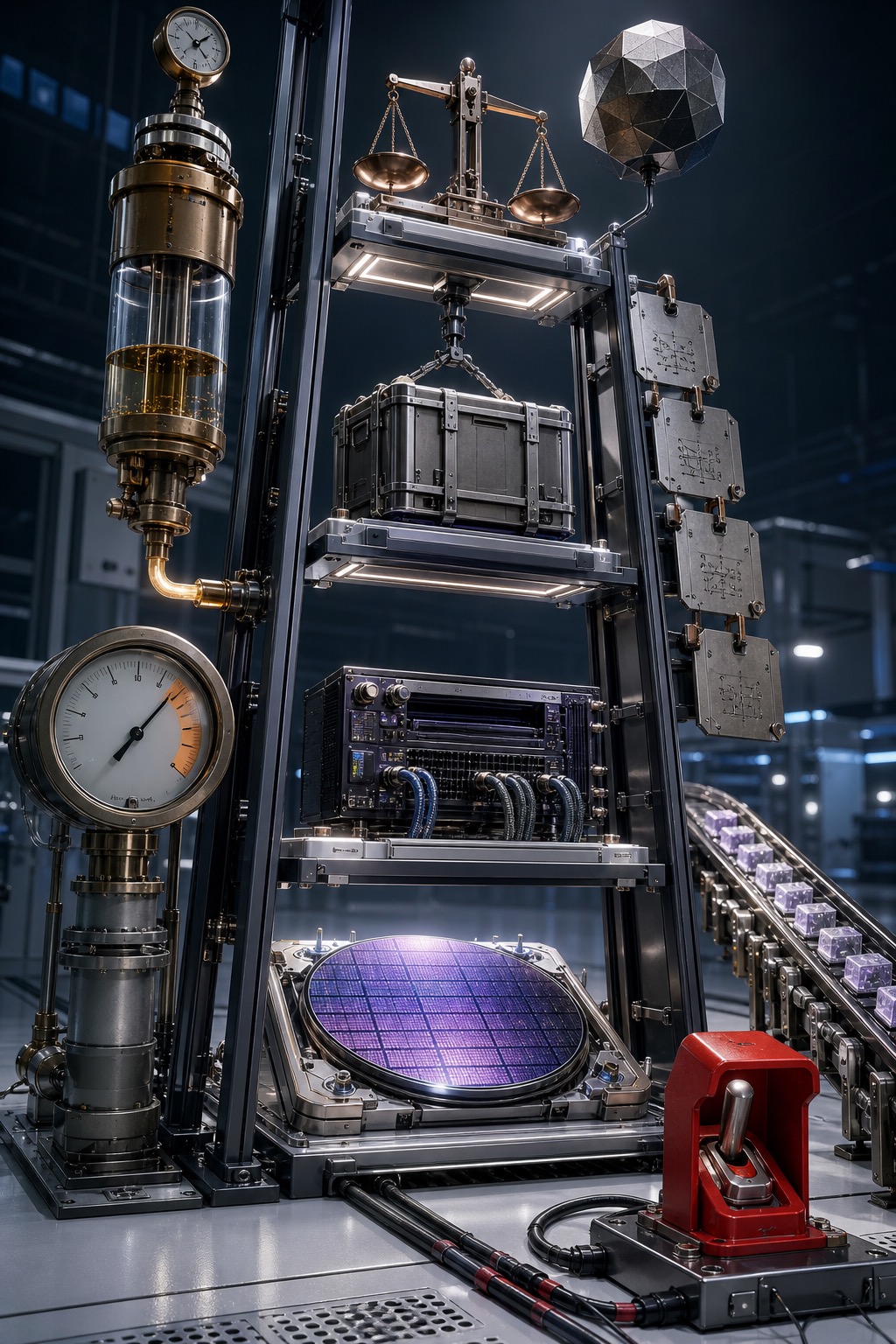
AI chip startups like to sell a breakthrough. Infrastructure buyers have to buy a system.
Etched said this week that it raised $300 million at a $10.3 billion valuation. The privately held company is not pitching a standalone accelerator: it is building inference clusters that combine custom silicon, memory, interconnects, cooling, racks, software, and manufacturing.
That is the real signal. Etched's financing validates investor interest in specialized inference, while its reported contracts signal buyer demand. Neither validates production performance. Buyers should treat readiness as a four-layer proof problem: silicon, system, delivery, and economics.
The Evidence—and the Gap
Etched says its first A0 silicon returned from TSMC's N4P process, its first racks are being validated with customers, and shipments will begin this summer. It has opened a new 10-megawatt lab and says it has started fabricating hundreds of millions of dollars of inference clusters.
The commercial numbers are equally striking: more than $1 billion in company-reported customer contracts and a valuation that TechCrunch says roughly doubled in seven months.
But bookings are not revenue, private demos are not public benchmarks, and early validation is not fleet reliability. Etched has not publicly named the customers, disclosed contract terms, or released third-party performance results. Those are not footnotes. They define the next stage of proof.
The Inference Proof Ladder
1. Silicon Proof
A working chip answers the first question: can the architecture run?
The next questions are harder. Buyers need reproducible benchmark methodology, supported-model coverage, compiler maturity, numerical behavior, and results across dense models, mixture-of-experts workloads, long context, and alternative architectures. A peak number matters less than performance on the buyer's actual traffic.
2. System Proof
Etched's own design makes the rack—not the chip—the useful boundary.
Its pitch separates prefill throughput from decode latency, using low-voltage inference and a shared memory pool across chips. That means evaluation must include tail latency, tokens per watt, thermal stability, interconnect behavior, failure recovery, observability, and performance under mixed workloads.
The procurement artifact should be a workload trace, not a slide.
3. Delivery Proof
Hardware becomes infrastructure only when it can be manufactured, installed, repaired, and supported repeatedly.
Operators should ask for yield history, shipment cadence, burn-in procedures, spare capacity, field-service coverage, firmware-update controls, and rollback paths. A successful rack in a lab proves engineering. A supported fleet proves operations.
4. Economic Proof
The final metric is not theoretical speed. It is the cost of a delivered, reliable token.
That calculation should include utilization, power, cooling, networking, software migration, model-porting work, downtime, support, and contract flexibility. Specialized hardware can win a benchmark yet lose the workload if switching costs or idle capacity erase the advantage.
What Builders Should Do
Infrastructure teams evaluating a new accelerator should create a proof ladder before a vendor trial:
1. Bring representative prompts, model shapes, batch patterns, and latency targets.
2. Measure the complete rack under sustained mixed traffic.
3. Test failure, recovery, monitoring, and software portability.
4. Model cost per delivered token at realistic utilization.
5. Tie commercial commitments to benchmark, shipment, and support milestones.
For founders, the surrounding opportunity is large. New inference systems need independent benchmarks, portability layers, hardware-aware schedulers, observability, capacity planning, and deployment services. The winning product may be the one that makes unfamiliar compute safe to adopt.
The Takeaway
Etched has cleared expensive early gates: capital, first silicon, facilities, and reported demand. The harder gates are now visible.
In AI infrastructure, production is not a postscript to the chip. Production is the proof.