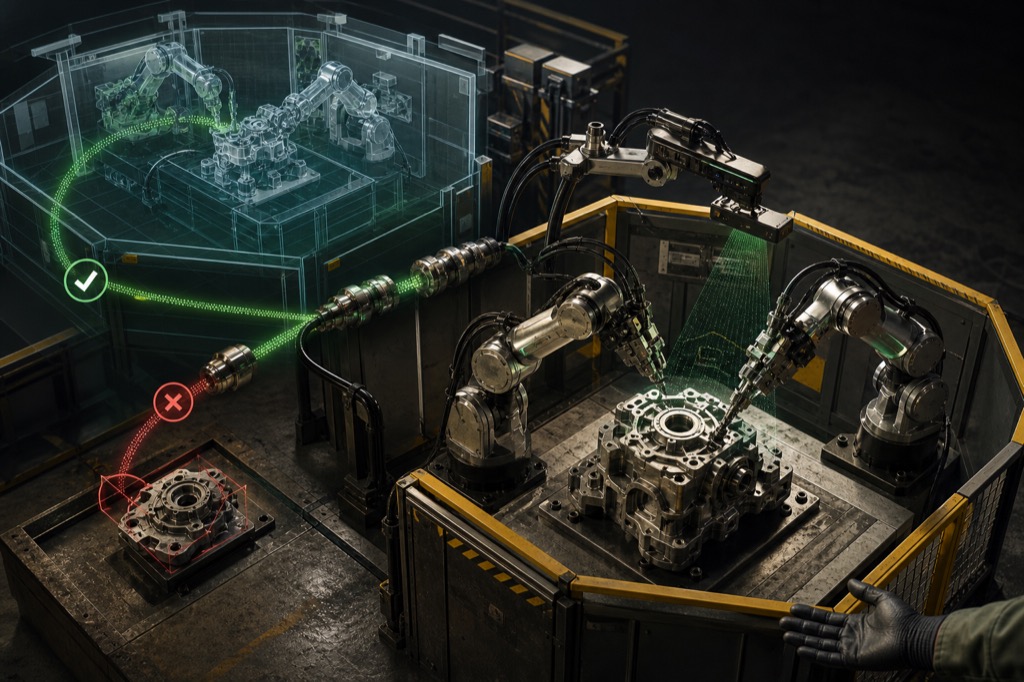
A robot that can move but cannot tell whether the job is finished is not autonomous. It is a machine waiting for a supervisor—or an incident.
That is the important shift inside Google's Gemini Robotics 2 release. The headline capabilities are whole-body control, dexterous manipulation, and multi-robot collaboration. The more useful operator signal is that Google is separating physical AI into an execution layer and a task-state layer that watches progress, detects key moments, retries failures, and coordinates handoffs.
The next robotics control plane will not just answer, “What should the robot do?” It will have to prove, “What happened, is the task complete, and what happens next?”
Three Models, One Operating Stack
Google DeepMind introduced three related models on July 30:
- Gemini Robotics 2 converts vision and language into motor control for humanoids and bi-arm robots.
- Gemini Robotics ER 2 handles embodied reasoning, multi-step planning, tool orchestration, and collaboration.
- Gemini Robotics On-Device 2 runs locally and is designed to adapt to new robot bodies with a few hours of data—typically fewer than 200 examples, according to Google.
Axios independently described the release as spanning the same two core layers: models for physical actions and models for higher-level task planning.
The split matters. A production robot may need a planner to interpret intent, a vision-language-action model to execute movement, deterministic controllers to enforce limits, and a separate observer to decide whether the result is acceptable. Treating all of that as one “robot model” hides the failure boundaries.
The Hard Problem Is Knowing When to Stop
Google says ER 2 can manage sequences lasting several minutes and involving hundreds of decisions. Its progress classifier assigns video frames to five completion bands. Google reports 57.4% accuracy on that test.
That figure is useful precisely because it is not close to perfect. Progress understanding is improving, but it is not solved.
On a separate moment-finding test—identifying the frame when an event such as a cup becoming full occurs—Google reports 91.3% accuracy, a 0.96-second mean absolute distance, and four-times execution speed relative to the larger model category in its comparison. These are vendor-run evaluations, not independent field results.
The release also exposes uneven motor capability. Google's published multi-finger task results range from 32% for using a dustpan to 92% for unscrewing a bulb. Three gripper categories on a Franka Duo range from 74.2% to 89.6%. A polished demo can conceal that task, tool, and embodiment still change the risk substantially.
Run the DONE Loop
Operators need a system contract around the model. Use Define, Observe, Navigate, Escalate.
Define completion evidence
Write the acceptance condition before the robot acts. “Clear the table” is ambiguous. A testable contract names allowed destinations, fragile items, forbidden zones, and the sensor evidence that proves each object was handled.
Observe continuously
Do not wait for the final frame. Record state transitions, tool calls, controller responses, sensor confidence, and elapsed time. The observer should be able to distinguish slow progress from a blocked action and apparent completion from verified completion.
Navigate recovery and handoffs
A retry is part of the workflow, not an exception. Define which failures can trigger another attempt, which require a different robot or tool, and which invalidate the whole task. Multi-robot collaboration only becomes operational when ownership and state transfer are explicit.
Escalate uncertainty
Set thresholds that route low-confidence states to a person or deterministic safety layer. Google's model card explicitly warns users to apply discretion in production and public settings and not to use the robotics models for safety-critical work such as healthcare or transportation.
Buy Completion Evidence
For a first deployment, choose one bounded workflow and track four measures:
- false-completion rate;
- human interventions per successful task;
- recovery time after a failed step;
- successful handoffs between models, robots, or people.
This creates a founder opportunity beyond robot hardware: vendor-neutral task verification, replayable event logs, fleet handoff protocols, and evaluation tools that test completion under real site conditions.
Gemini Robotics 2 is not proof that general-purpose robots are ready. It is evidence that the robotics stack is becoming modular enough to inspect. The teams that win will not be the ones whose robots start the most tasks. They will be the ones that can prove how those tasks ended.