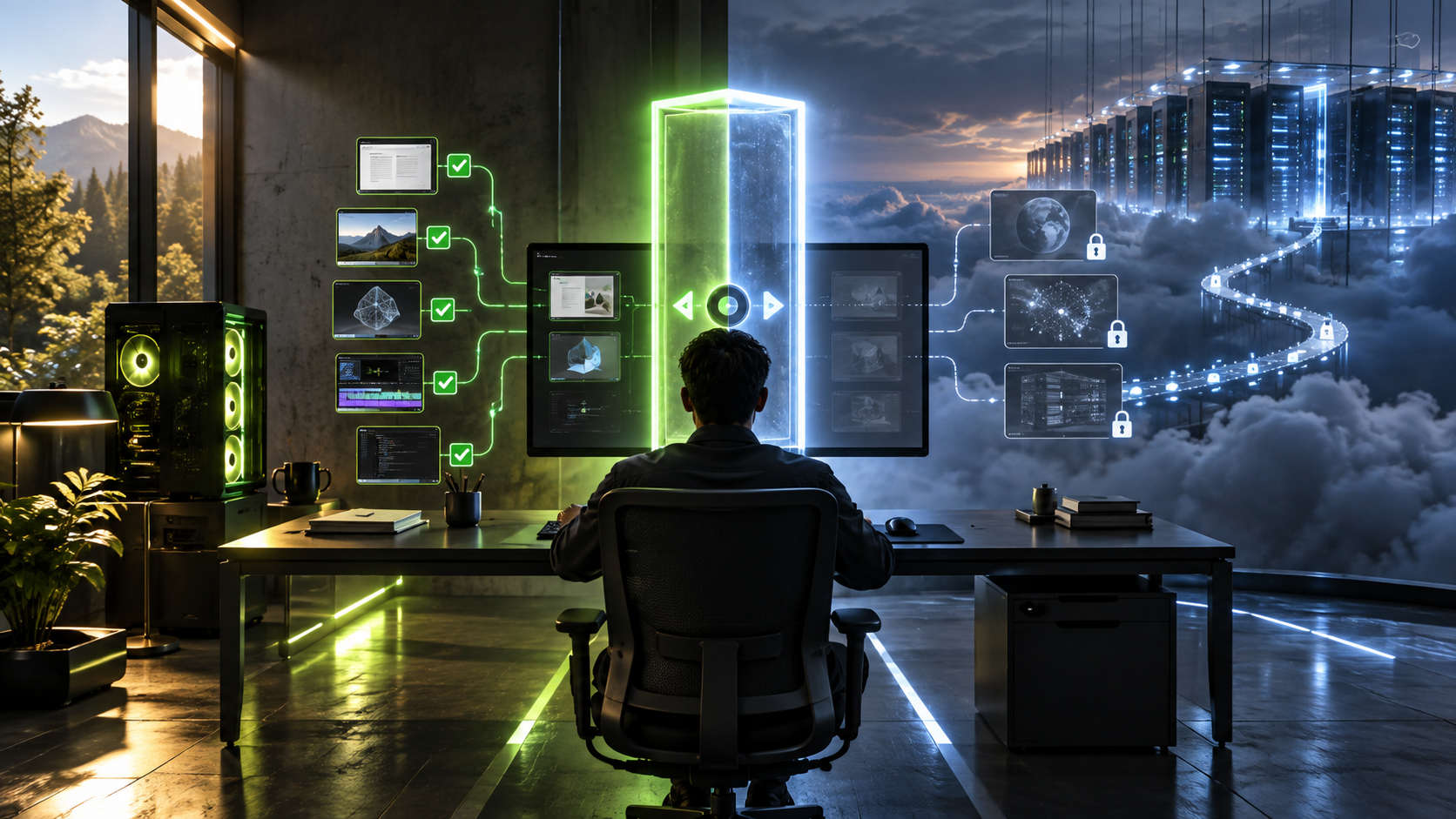
Perplexity Portable Computer is now available through the Perplexity app on compatible Windows systems using NVIDIA hardware. The notable operator question is not simply where a model runs, but how a task moves between local and cloud resources while preserving an explicit user decision point.
What the evidence says
NVIDIA Blog reports that Portable Computer supports compatible GeForce RTX PCs and RTX PRO Workstations. It describes the product as a local form of Perplexity Computer that can plan and perform multistep tasks.
The published account says setup includes a local model, with Qwen 3.8 27B offered as an example. That model is described as post-trained for Perplexity Computer and optimized for RTX GPUs. The account also says local operation does not require cloud credits.
Some work may still move beyond the device. When Portable Computer identifies a task as requiring more advanced reasoning, it can request permission before sending information to cloud support. The evidence therefore presents a hybrid execution model rather than an exclusively local system.
Operator implications
Operator analysis: the permission request is the most consequential control described in the evidence. It makes cloud escalation a visible event instead of an entirely hidden routing decision. Teams evaluating the product can treat that moment as a practical boundary: routine work may remain local, while selected tasks can seek additional reasoning resources only after user approval.
The local model and hardware optimization also suggest that deployment readiness depends on the complete system, not merely access to an application. Operators would need to evaluate whether their compatible machines, chosen tasks, and tolerance for cloud escalation align with the described workflow.
A useful operating test would separate tasks into three observed paths: completed locally, escalated with permission, and not completed after permission is withheld. Recording those outcomes would help clarify how often the cloud boundary matters in actual use without assuming results that the evidence does not provide.
Limits and open questions
This briefing relies on a single primary account that is not independently confirmed. The evidence pack does not establish performance, output quality, adoption, the full compatibility list, how frequently tasks require cloud support, what information would be sent for a particular task, or what happens when a user declines permission.
It also provides no comparative results against other local or cloud approaches. The supported conclusion is limited: Portable Computer has been presented as available on compatible Windows RTX systems, with local multistep execution and permission-based cloud escalation. Its practical reliability and operating value remain open questions requiring direct evaluation.