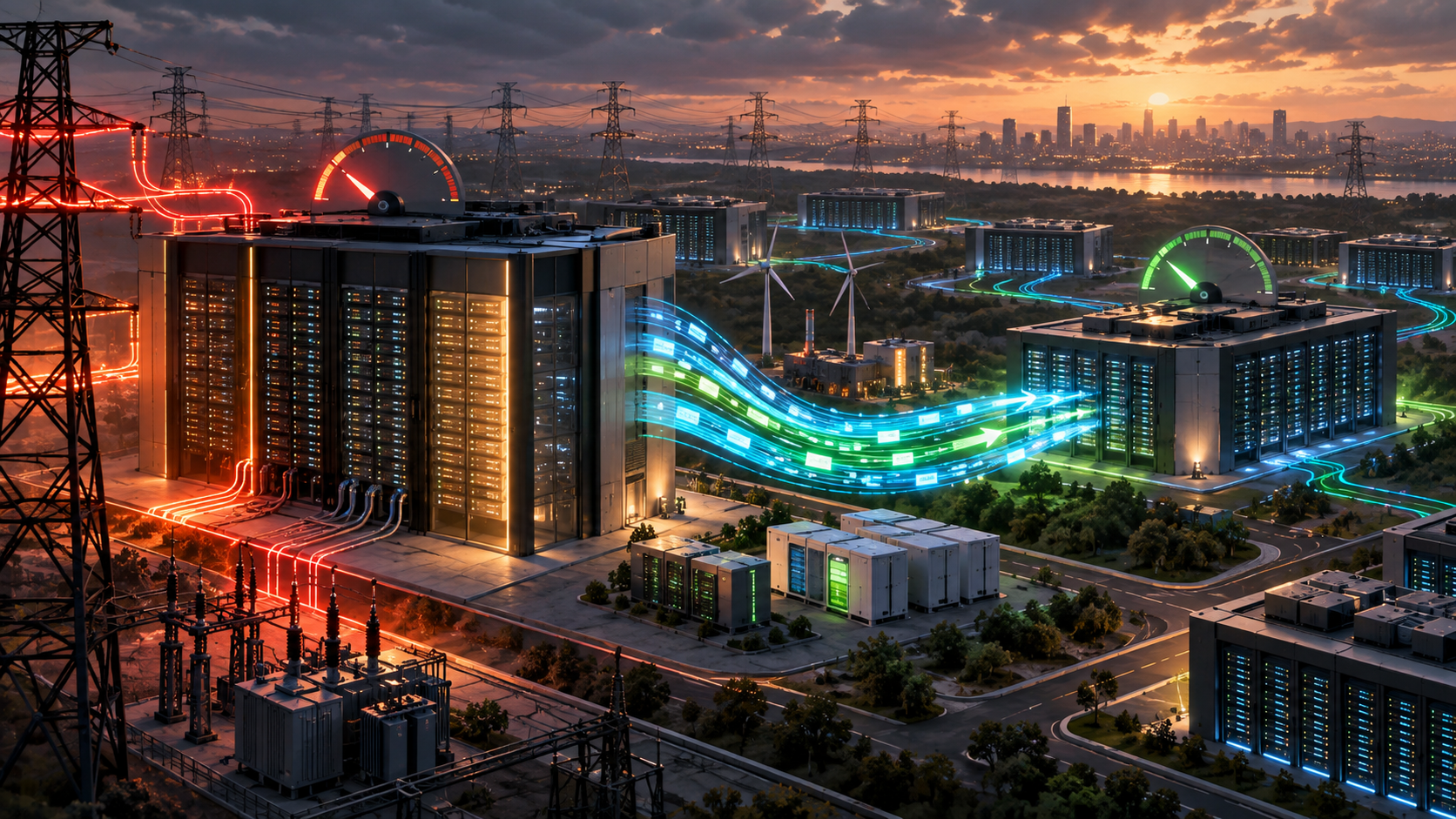
The emerging proposition is that data centers could make room for additional computing by varying when and where they draw electricity. That is the strategic premise behind a new alliance announced by Emerald AI, Google, and NVIDIA, with independent reporting adding detail about its participants and intended operating model.
What the evidence says
In its primary announcement, NVIDIA says Emerald AI, Google, and NVIDIA launched the AI Energy Management Alliance, or AEMA. NVIDIA characterizes it as a first-of-its-kind coalition focused on data centers that can dynamically adjust electricity consumption in response to grid conditions.
The announcement identifies several possible sources of flexibility: shifting computing workloads, discharging storage, using paired generation, and responding to system contingencies. NVIDIA says effective use of these methods could improve utilization of existing grid capacity, reduce demand during stressful periods, and avoid or postpone infrastructure upgrades. These are stated potential benefits, not reported results from a completed deployment.
TechCrunch independently reports that Anthropic joined the founding trio, along with utilities AES, Constellation, National Grid, and NRG Energy. Its account says Emerald AI’s software coordinates utility requests with data centers. Those facilities can then pause noncritical tasks or move loads to other data centers where grid headroom is available.
TechCrunch also cites a Goldman Sachs study published the previous year. According to that secondhand account, holding maximum grid usage to 90% for several hours at a time could release 76 gigawatts of capacity. The figure is a conditional study estimate rather than a measured outcome attributed to AEMA.
Operator implications
If the model works as described, workload flexibility becomes an operational resource. Data-center operators would need to distinguish tasks that can be paused from those that cannot, identify alternate facilities with available grid headroom, and coordinate those decisions with utility requests.
The range of mechanisms in NVIDIA’s announcement also suggests that flexibility is broader than workload scheduling alone. Storage, paired generation, and responses to system contingencies could all affect how much electricity a facility draws from the grid at a given moment.
For operators, the central question is therefore not simply whether capacity exists. It is whether computing demand can be reorganized safely and repeatedly around periods of grid pressure. The alliance’s significance rests on turning that proposition into a workable coordination model across data centers and utilities.
Limits and open questions
Neither source establishes how widely the approach has been deployed, how often participating data centers can reduce demand, or how much capacity AEMA itself has made available. The evidence also does not specify implementation timelines, operating costs, technical architecture, or arrangements between utilities and data-center participants.
The 76-gigawatt estimate should be treated cautiously because the available account provides no underlying assumptions or methodology from the cited study. It remains unknown how closely that scenario matches the facilities involved in the alliance.
The evidence supports the existence of the coalition and its proposed mechanisms. Whether those mechanisms can consistently create meaningful grid headroom without disrupting computing workloads remains an open operational question.