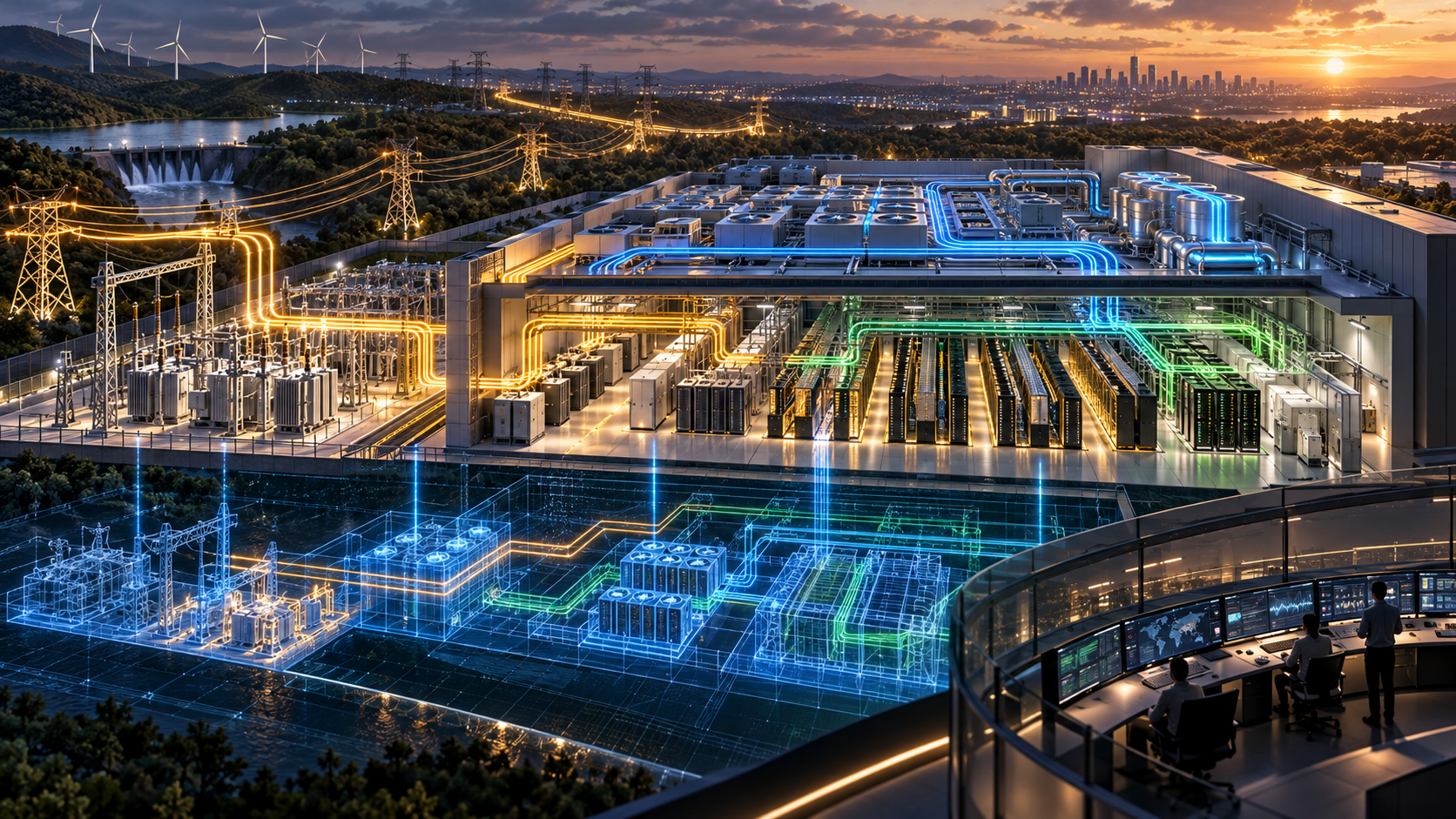
The primary account describes NVIDIA DSX as an effort to treat an AI factory and the systems supplying it as a connected operating environment. Its reported scope links planning, simulation, and operation across infrastructure layers rather than presenting power, cooling, compute, networking, and operations as separate concerns.
What the evidence says
NVIDIA Blog says companies are using the NVIDIA DSX AI Factory Platform to plan, simulate, and run AI factories as one system. The described model extends from the substation to the rack and connects grid planning with AI factory operation.
The account identifies Schneider Electric, AVEVA, and ETAP as advancing DSX with validated NVIDIA Vera Rubin power and cooling reference architectures and an NVIDIA Omniverse-powered AI factory digital twin. It also describes DSX MaxLPS and DSX Exchange as tools intended to get more compute from each watt while securely sharing signals among compute, networking, energy, cooling, and operations.
DSX Flex is described as synchronizing AI factory demand with grid conditions and onsite generation. In the source’s framing, that would allow AI factories to function as flexible grid assets rather than static loads.
Operator implications
The substantive implication is a shift in where the power bottleneck is understood. Rather than residing only in a facility, a rack, or a grid connection, the reported approach treats it as a relationship among several systems whose conditions must be considered together.
If the described signal sharing and demand synchronization work as intended, operators could assess compute demand alongside power availability, cooling, networking, and operational conditions. The digital-twin and reference-architecture elements suggest a connection between planning before deployment and decisions during operation. This is an interpretation of the stated platform design, not a demonstrated result.
The key operational question is whether a shared view across these layers can support dependable decisions when conditions change. The account establishes the intended coordination model; it does not show how that model performs in use.
Limits and open questions
This is a single primary account and is not independently confirmed. It does not establish how many companies are using DSX, where it is operating, or the maturity of reported deployments.
The source also does not establish measured efficiency gains, grid outcomes, implementation costs, deployment timelines, reliability, compatibility requirements, security controls, failure behavior, or operational results. It supports a description of the platform and its stated capabilities, but not conclusions about effectiveness or impact.